

What is Hydrological Cycle?
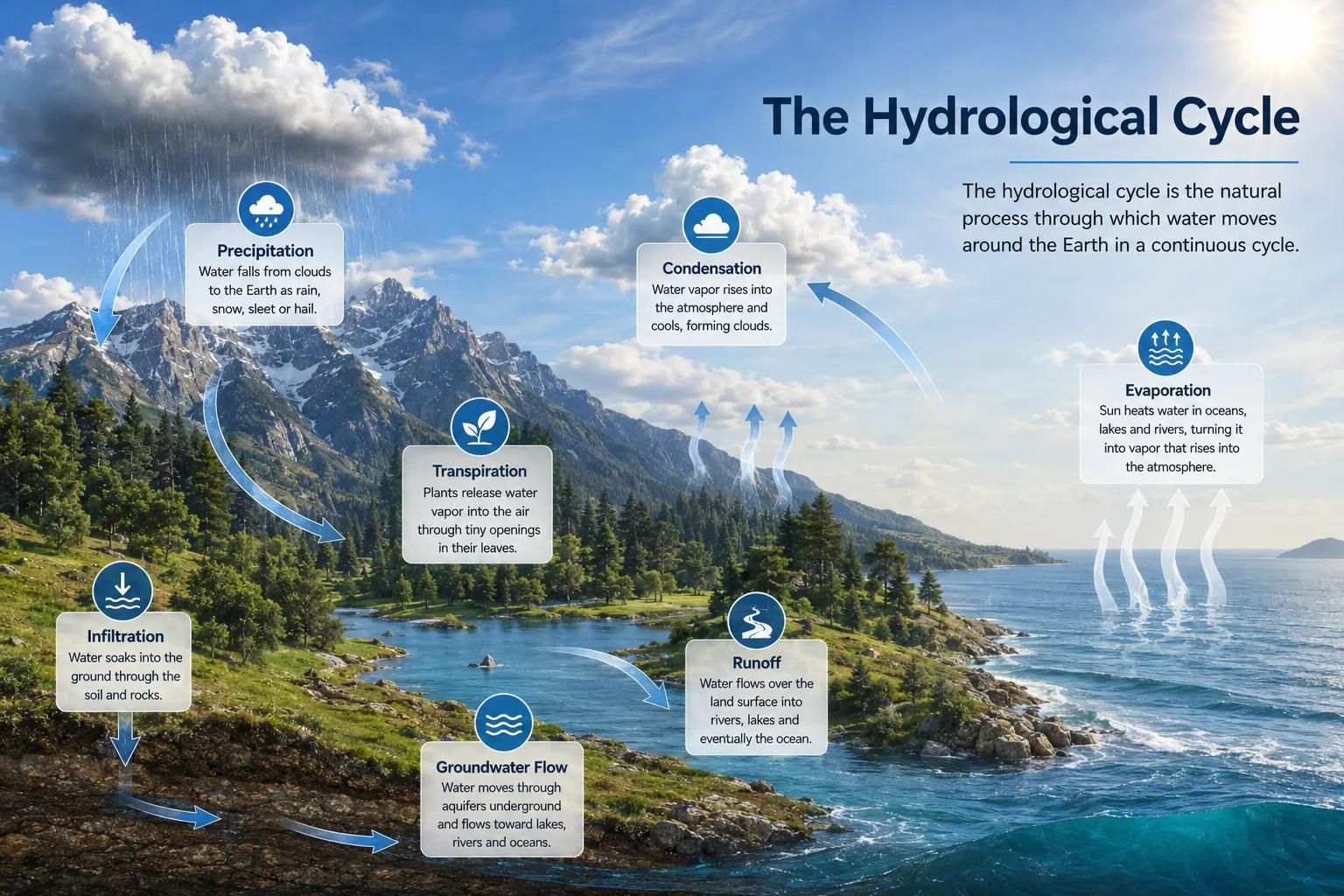
The hydrological cycle, also known as the water cycle process, describes the endless movement of water across three key environments: the atmosphere, the land surface, and underground aquifers. It is driven by solar energy and gravity. Water evaporates from oceans and water bodies, rises into the atmosphere, condenses to form clouds, falls back as precipitation, and eventually returns to the ocean through rivers and groundwater circulation. This hydrological system operates at a planetary scale, yet its local variations directly affect groundwater availability, river flows, and climate patterns in every region of India.
Stages of Hydrological Cycle
A complete understanding of what is hydrological cycle requires studying its major stages. Each stage plays a critical role in maintaining the hydrological system and sustaining water resources:
- Evaporation: Solar heat converts surface water from oceans, lakes, and rivers into water vapour, driving the entire water cycle process upward into the atmosphere.
- Condensation: As water vapour rises and cools, it condenses around atmospheric particles to form clouds and fog — storing water temporarily above the land surface.
- Precipitation: Condensed water falls back as rain, snow, sleet, or hail. Rainfall and groundwater recharge are directly linked at this stage.
- Infiltration: A significant portion of precipitation seeps into the soil. This infiltration feeds the aquifer recharge process, replenishing underground water reserves.
- Runoff: Excess water that cannot infiltrate flows over the surface as runoff, feeding streams, rivers, and eventually the ocean — completing surface water flow.
- Groundwater Recharge: Deep infiltration slowly recharges underground aquifers. Understanding this stage is fundamental to groundwater recharge cycle analysis and sustainable water resource management.
- River & Ocean Circulation: Rivers carry surface and groundwater back to oceans, completing the loop of river and groundwater interaction across watersheds.
Importance of Hydrological Cycle
The hydrological cycle process is not just a textbook concept — it is the backbone of all water-dependent life and infrastructure. Here is why it matters deeply for environmental hydrology and water resource planning:
- Replenishes groundwater reserves through the aquifer recharge process, supporting millions of wellsand borewells across India.
- Regulates regional climate and rainfall patterns through climate and water cycle interactions.
- Supports agriculture and irrigation through seasonal precipitation and watershed hydrologymanagement.
- Maintains environmental ecosystem balance by sustaining river flows, wetlands, and biodiversity.
- Provides a scientific foundation for water conservation systems and hydrological investigation.
At Bhoojal Survey, our team applies this scientific understanding directly in the field — conducting hydrogeological survey using SSRMPATS Instrument, GER DETECT, and PQWT at site for open well / borewell location. Our advanced hydrological and groundwater survey solutions combine scientific water resource investigation and analysis with practical field expertise, ensuring reliable results for every project.
Applications of Hydrological Cycle Studies
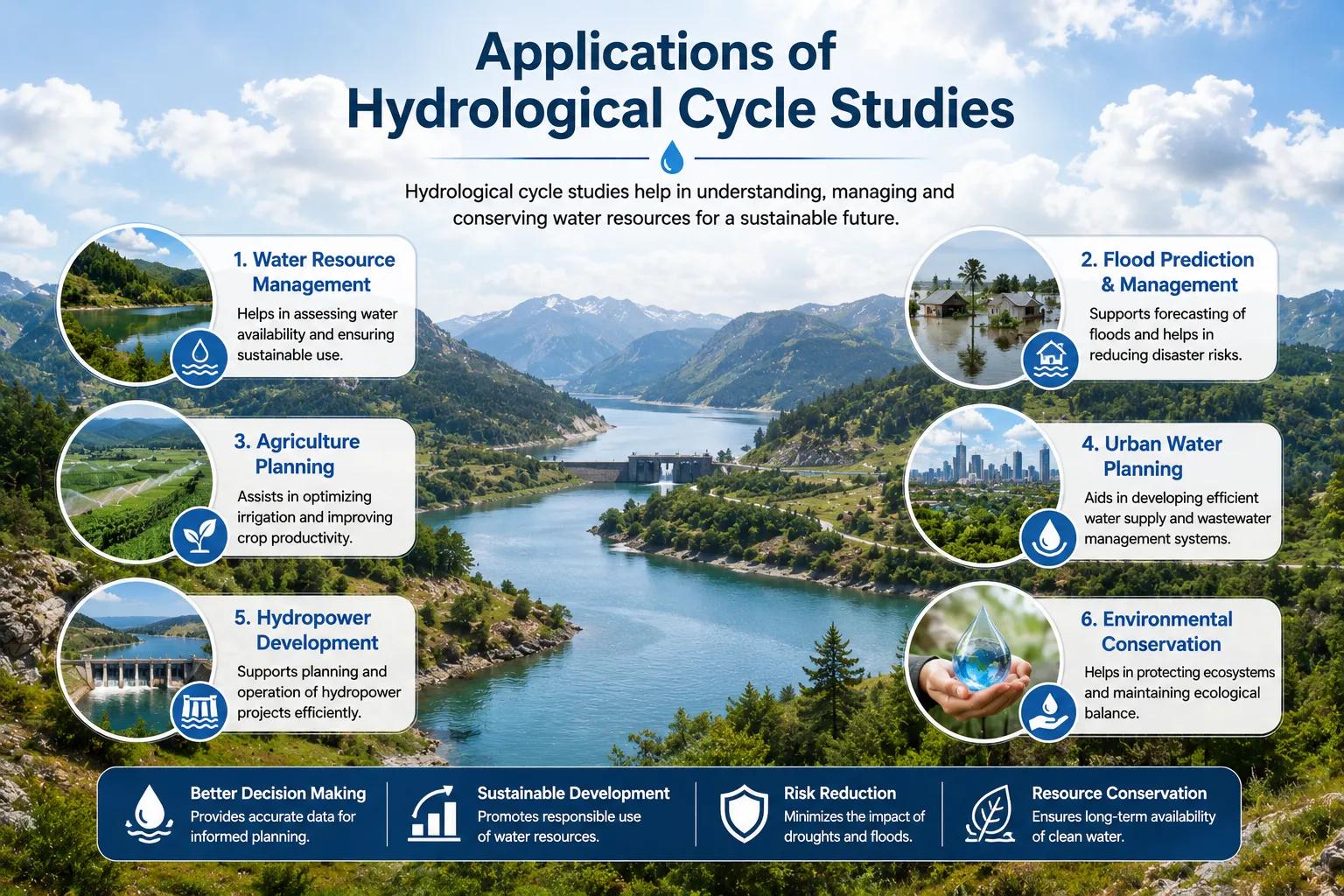
Knowledge of what is hydrological cycle directly powers multiple real-world applications in water resource consultancy and environmental planning:
- Groundwater Management Projects: Mapping aquifer recharge zones for sustainable extraction planning.
- Watershed Management: Analysing watershed hydrology to prevent degradation and improve water retention.
- Flood Risk Assessment: Modelling infiltration and runoff patterns to predict and manage flood events.
- Irrigation Planning: Designing systems aligned with rainfall and groundwater recharge cycles for efficient agriculture.
- Environmental Impact Assessment (EIA): Evaluating how development projects alter the hydrological system.
- Climate & Rainfall Analysis in India: Studying seasonal precipitation patterns and their impact on groundwater recharge.
- River Basin Management: Integrating surface water flow and groundwater circulation data for comprehensive basin planning.
Why Choose Bhoojal Survey
Bhoojal Survey is a trusted name in professional hydrological consultancy across India. We bring together scientific expertise, advanced field technology, and deep regional knowledge to deliver accurate and actionable water resource solutions.
- Experienced Hydrology Experts: Over a decade of hands-on experience in hydrological investigation, groundwater surveys, and environmental assessments.
- Advanced Technologies: We use instruments like SSRMPATS, GER DETECT, and PQWT for precise subsurface analysis.
- Scientific Groundwater Analysis: Every project is backed by rigorous scientific hydrological analysis and detailed reporting.
- Pan-India Survey Services: From Himalayan watersheds to Deccan aquifers — we cover all hydrogeological zones across India.
- Customised Water Resource Solutions: Tailored hydrological investigation services for government agencies, infrastructure developers, agriculture planners, and environmental consultants.
Conclusion
Understanding what is hydrological cycle is fundamental to every water resource, environmental, and groundwater project. The hydrological cycle process governs how water is replenished, distributed, and consumed across the planet. From rainfall and groundwater recharge to river and groundwater interaction, every stage directly impacts agricultural productivity, infrastructure planning, and environmental sustainability in India.
Whether you are planning a borewell, managing a watershed, assessing flood risk, or developing an irrigation network — a scientifically sound hydrological investigation is the foundation of success. Bhoojal Survey combines expertise in environmental hydrology, advanced survey technology, and professional water resource consultancy to deliver reliable results across India.
■ Contact Bhoojal Survey Today for Professional Hydrological Investigation & Water Resource Consultancy Services Across India
Frequently Asked Questions (FAQs)
1. What is hydrological cycle in simple words?
The hydrological cycle is the continuous process by which water moves from the Earth's surface to the atmosphere and back again through evaporation, condensation, precipitation, infiltration, and runoff. It is nature's system for recycling and distributing freshwater across the planet.
2. What are the main stages of the hydrological cycle?
The main stages of the hydrological cycle process are: evaporation, condensation, precipitation, infiltration, surface runoff, groundwater recharge, and river and ocean circulation. Each stage is interconnected and essential for maintaining freshwater availability.
3. Why is the hydrological cycle important for groundwater in India?
In India, the hydrological cycle directly controls groundwater recharge through seasonal rainfall and infiltration. Understanding the aquifer recharge process helps water resource engineers and groundwater survey agencies identify optimal borewell locations, manage water tables, and plan sustainable extraction — especially in rain-dependent states.
4. How does groundwater recharge happen in the hydrological cycle?
Groundwater recharge occurs when precipitation infiltrates through soil and rock layers, slowly percolating down to replenish underground aquifers. The rate of recharge depends on soil type, land cover, rainfall intensity, and rock permeability — factors that are scientifically analysed during hydrological investigation and groundwater survey projects.
5. What is the role of evaporation in the water cycle process?
Evaporation is the starting engine of the hydrological cycle. Solar energy converts liquid water from oceans, lakes, rivers, and moist soil into water vapour. This vapour rises into the atmosphere, where it eventually condenses and falls back as precipitation — completing the water cycle process and replenishing both surface water and groundwater resources.