


Indroduction
Water is the foundation of all life on Earth. It moves continuously through the environment — from oceans to clouds, from rainfall to rivers, and from soil to groundwater — in a never-ending process known as the hydrological cycle. Understanding what is hydrological cycle is essential for water resource planning, watershed management, agricultural sustainability, and environmental protection.
At Bhoojal Survey, our team of expert hydrologists and water resource scientists applies deep knowledge of hydrological processes to deliver reliable surveys, groundwater investigations, and water management solutions across India.
What is Hydrological Cycle?
The hydrological cycle — also called the water cycle — is the continuous natural process by which water moves through the Earth's atmosphere, land surface, and subsurface systems. It maintains the balance of freshwater across the planet by recycling water through evaporation, condensation, precipitation, infiltration, and runoff.
In simple terms, the hydrological cycle explains how water circulates from the oceans into the atmosphere, falls as rain or snow over land, flows into rivers and underground aquifers, and eventually returns to the oceans — completing the cycle.
This process forms the backbone of hydrology and water resource management, making it a critical area of study for scientists, engineers, and planners worldwide.
Stages of the Hydrological Cycle
The hydrological cycle operates through several interconnected stages:
Evaporation — Heat from the sun causes water from oceans, lakes, and rivers to convert into water vapour and rise into the atmosphere.
Transpiration — Plants release water vapour through their leaves, contributing significantly to atmospheric moisture alongside evaporation. Together, this is called evapotranspiration.
Condensation — As water vapour rises and cools at higher altitudes, it condenses around dust particles to form clouds and fog.
Precipitation — Water falls back to Earth's surface as rain, snow, sleet, or hail, replenishing rivers, lakes, and soil moisture.
Infiltration — A portion of precipitation seeps into the soil and moves downward through rock layers, recharging groundwater aquifers — a process critical for borewell and open well sustainability.
Surface Runoff — Excess water that cannot infiltrate the soil flows overland into streams, rivers, and eventually back into the ocean, shaping watersheds and drainage basins.
Groundwater Recharge — Water that infiltrates deep enough reaches the water table, replenishing underground aquifers that supply millions of people with drinking water and irrigation needs.
Each stage is interdependent. A disruption in one stage — such as reduced infiltration due to urbanisation — can affect the entire hydrological system.
Importance of the Hydrological Cycle
The hydrological cycle performs critical functions that sustain both human civilisation and natural ecosystems:
Freshwater Availability — The water cycle continuously replenishes rivers, lakes, and underground aquifers, providing the freshwater needed for drinking, agriculture, and industry.
Groundwater Replenishment — Infiltration and percolation recharge deep aquifers, sustaining borewells and open wells even during dry seasons.
Agricultural Sustainability — Reliable precipitation patterns and soil moisture regulated by the hydrological cycle directly support crop production and irrigation planning across India.
Ecosystem Balance — Rivers, wetlands, and forests all depend on the regular movement of water through the water cycle to maintain biodiversity and ecological health.
Flood and Drought Management — Understanding hydrological processes allows water resource experts to predict, plan for, and mitigate both flood and drought events.
At Bhoojal Survey, we offer advanced hydrological and geophysical survey solutions, including conducting hydrogeological survey using SSRMPATS Instrument, GER DETECT, and PQWT at site for open well / borewell location. Our scientific water resource investigation and analysis services help clients make informed decisions about groundwater development and watershed management.
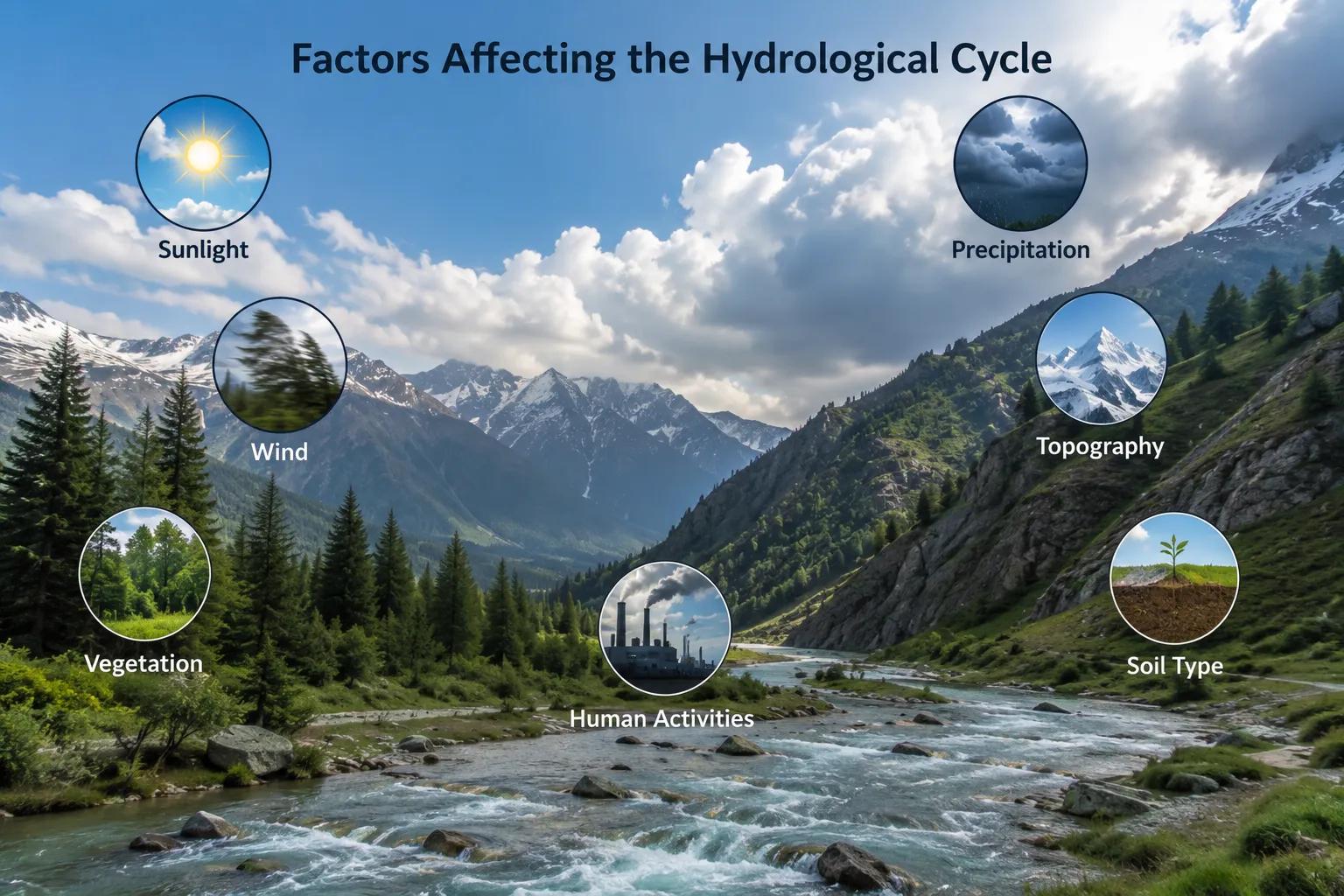
Factors Affecting the Hydrological Cycle
Human activity and environmental changes increasingly disrupt the natural hydrological cycle:
Climate Change — Altered temperature and rainfall patterns shift precipitation zones, increase extreme weather events, and accelerate glacial melt.
Deforestation — Removal of forests reduces transpiration and infiltration, increasing surface runoff and soil erosion.
Urbanisation — Impervious surfaces such as roads and buildings prevent infiltration, increasing flood risk and reducing groundwater recharge.
Groundwater Over-Extraction — Excessive pumping depletes aquifers faster than natural recharge can replenish them, threatening long-term water security.
Changes in Land Use — Agricultural expansion, mining, and construction alter natural drainage patterns and watershed hydrology.
Pollution — Contamination of surface and groundwater bodies degrades water quality and affects the availability of usable freshwater resources.
Addressing these threats requires scientific monitoring, hydrological investigations, and sustainable water resource management planning.
Why Choose Bhoojal Survey?
Bhoojal Survey is a trusted name in professional hydrological consultancy in India. Our team brings together experienced hydrologists, environmental scientists, and geophysical survey specialists to deliver accurate, reliable, and actionable results.
We provide:
- Experienced hydrologists with deep knowledge of watershed hydrology, groundwater systems, and environmental water management
- Advanced survey technologies for accurate hydrological and geophysical assessments
- Scientific watershed investigations tailored to river basins, irrigation projects, and flood management studies
- Professional technical reporting for environmental impact assessments, government agencies, and infrastructure developers
- Pan-India survey services covering diverse geological and hydrological conditions
- Customised water management solutions designed to meet the specific needs of each project
Whether you are a government agency planning a watershed development programme, an infrastructure developer requiring a flood study, or an agricultural planner assessing groundwater availability — Bhoojal Survey delivers the scientific expertise you need.
Conclusion
The hydrological cycle is one of nature's most vital processes, governing the availability and movement of freshwater across the Earth. Understanding what is hydrological cycle — from evaporation and precipitation to groundwater recharge and surface runoff — is fundamental for sustainable water resource management, disaster preparedness, and environmental conservation.
As water challenges grow across India, the need for scientific hydrological investigations has never been greater. Bhoojal Survey combines advanced technology, field expertise, and professional reporting to support water resource projects of every scale.
Contact Bhoojal Survey today to discuss your hydrological survey, groundwater investigation, or watershed management requirements. Our experts are ready to deliver precise, data-driven solutions for your water resource needs.
Frequently Asked Questions (FAQs)
Q1. What is the hydrological cycle? The hydrological cycle is the continuous natural process through which water moves between the Earth's surface, atmosphere, and underground systems. It includes stages such as evaporation, condensation, precipitation, infiltration, surface runoff, and groundwater recharge, maintaining the planet's freshwater balance.
Q2. What are the main stages of the hydrological cycle? The main stages of the hydrological cycle are evaporation, transpiration, condensation, precipitation, infiltration, surface runoff, and groundwater recharge. Each stage is interconnected and plays a vital role in sustaining freshwater resources across river basins, watersheds, and underground aquifers.
Q3. Why is the hydrological cycle important? The hydrological cycle is important because it continuously replenishes freshwater supplies, supports agriculture and ecosystems, regulates climate, and sustains groundwater reserves. For water resource management and hydrological survey services in India, understanding the water cycle is essential for planning and sustainability.
Q4. How does groundwater recharge occur in the hydrological cycle? Groundwater recharge occurs when precipitation infiltrates through the soil and porous rock layers, slowly percolating downward until it reaches underground aquifers. This process replenishes borewells and open wells and is a key focus of hydrological investigations conducted by water resource consultancies across India.
Q5. What factors affect the hydrological cycle? Key factors that affect the hydrological cycle include climate change, deforestation, urbanisation, land use changes, groundwater over-extraction, and pollution. These disruptions reduce infiltration, alter precipitation patterns, and deplete aquifers — highlighting the need for professional watershed analysis and water resource assessment consultancy.