
Introduction
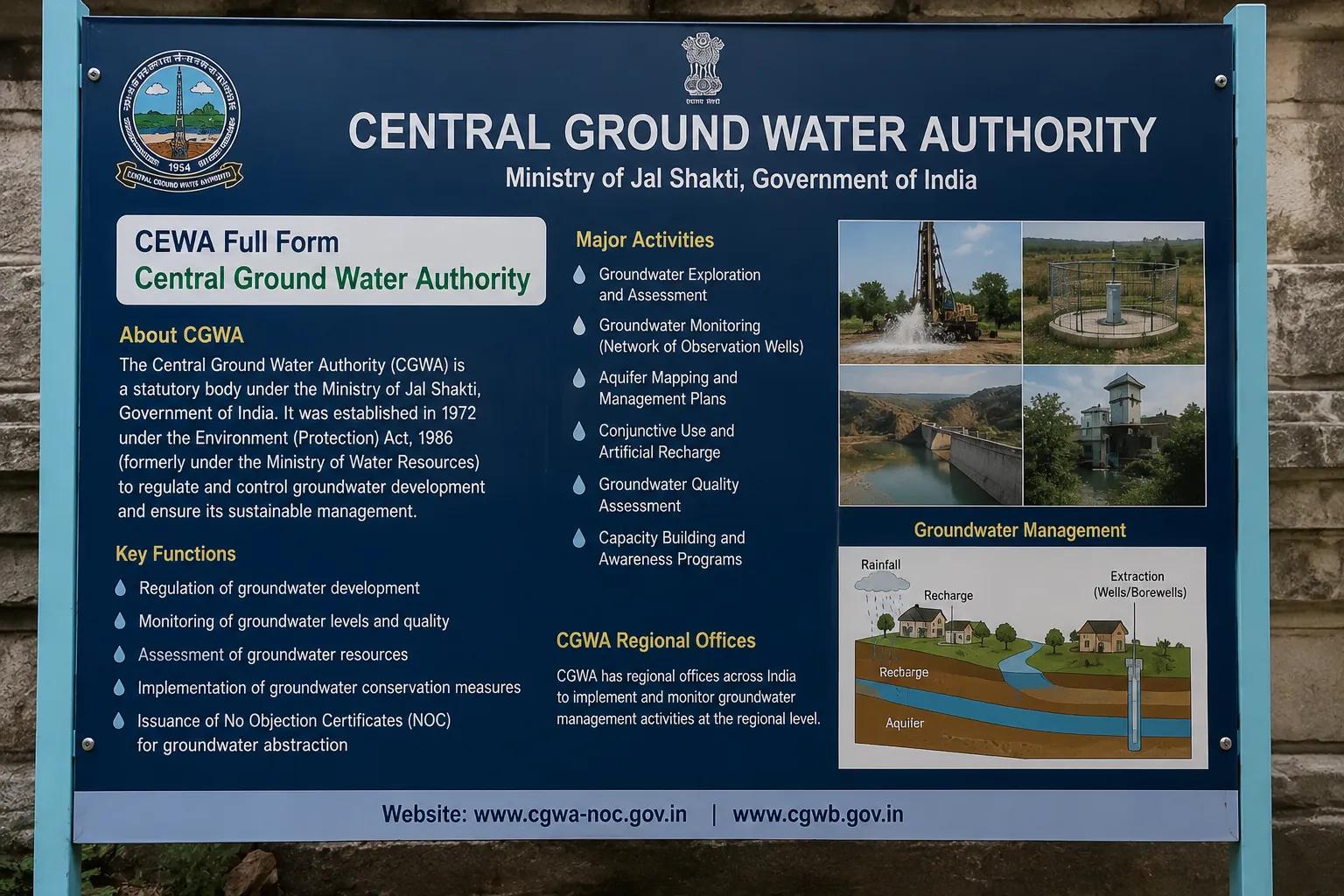
CGWA full form is Central Ground Water Authority. It is the primary regulatory body in India responsible for managing, controlling, and regulating groundwater extraction across the country. Established under the Environment (Protection) Act, 1986, CGWA operates under the Ministry of Jal Shakti and holds the legal authority to grant or deny permission for groundwater use.
In a country where groundwater is the backbone of agriculture, industry, and urban water supply, the role of CGWA is critical. Any industry, infrastructure project, or commercial establishment that extracts groundwater beyond permitted limits must obtain a formal No Objection Certificate (NOC) from CGWA. Understanding what CGWA means and how it functions is the first step toward legal, sustainable groundwater use.
What is the Full Form of CGWA
The CGWA full form is Central Ground Water Authority. It was constituted in 1997 by the Central Government under Section 3(3) of the Environment (Protection) Act, 1986.
CGWA's core mandate is to regulate and control the development and management of groundwater resources across India. It has the authority to:
- Issue directions for groundwater extraction regulation
- Grant NOC approvals for groundwater abstraction
- Designate over-exploited, critical, and semi-critical groundwater areas
- Enforce compliance among industries and large water users
- Promote sustainable and scientific groundwater management
CGWA works closely with the Central Ground Water Board (CGWB), State Ground Water Authorities, and the Ministry of Jal Shakti to implement national groundwater governance policies.
Role of CGWA in Groundwater Management
CGWA plays a central role in how groundwater is used across India — particularly in notified areas where extraction is restricted due to resource depletion or stress.
Key functions include:
- Groundwater extraction regulation — controlling how much water industries and establishments can legally withdraw
- NOC approval process — evaluating applications for groundwater abstraction based on hydrogeological data and environmental impact
- Groundwater conservation — identifying and protecting recharge zones and over-exploited aquifers
- Compliance monitoring — tracking groundwater usage through metering, reporting, and periodic reviews
- Sustainable groundwater usage — promoting rainwater harvesting and artificial recharge as conditions for NOC approvals
Failure to comply with CGWA guidelines can lead to legal penalties, project stoppages, and cancellation of environmental clearances.
Who Needs CGWA Approval
CGWA approval is mandatory for a wide range of users who extract groundwater beyond specified thresholds or operate in notified groundwater-stressed areas. This includes:
- Industries — manufacturing plants, food processing units, textile factories, and chemical industries
- Infrastructure projects — highways, tunnels, metro projects, and large construction sites
- Mining operations — where dewatering affects local aquifers significantly
- Commercial establishments — hotels, hospitals, malls, and residential complexes above a certain scale
- Large groundwater extraction users — anyone abstracting more than 10 cubic meters per day in notified areas
Obtaining CGWA approval requires a detailed hydrogeological investigation report, supported by field survey data. Professional consultants conduct these assessments using advanced groundwater and geophysical survey solutions — including conducting hydrogeological surveys using SSRMPATS Instrument, GER DETECT, and PQWT at site for open well and borewell location identification. This scientific groundwater investigation and analysis forms the technical backbone of a credible CGWA application.
Benefits of CGWA Compliance
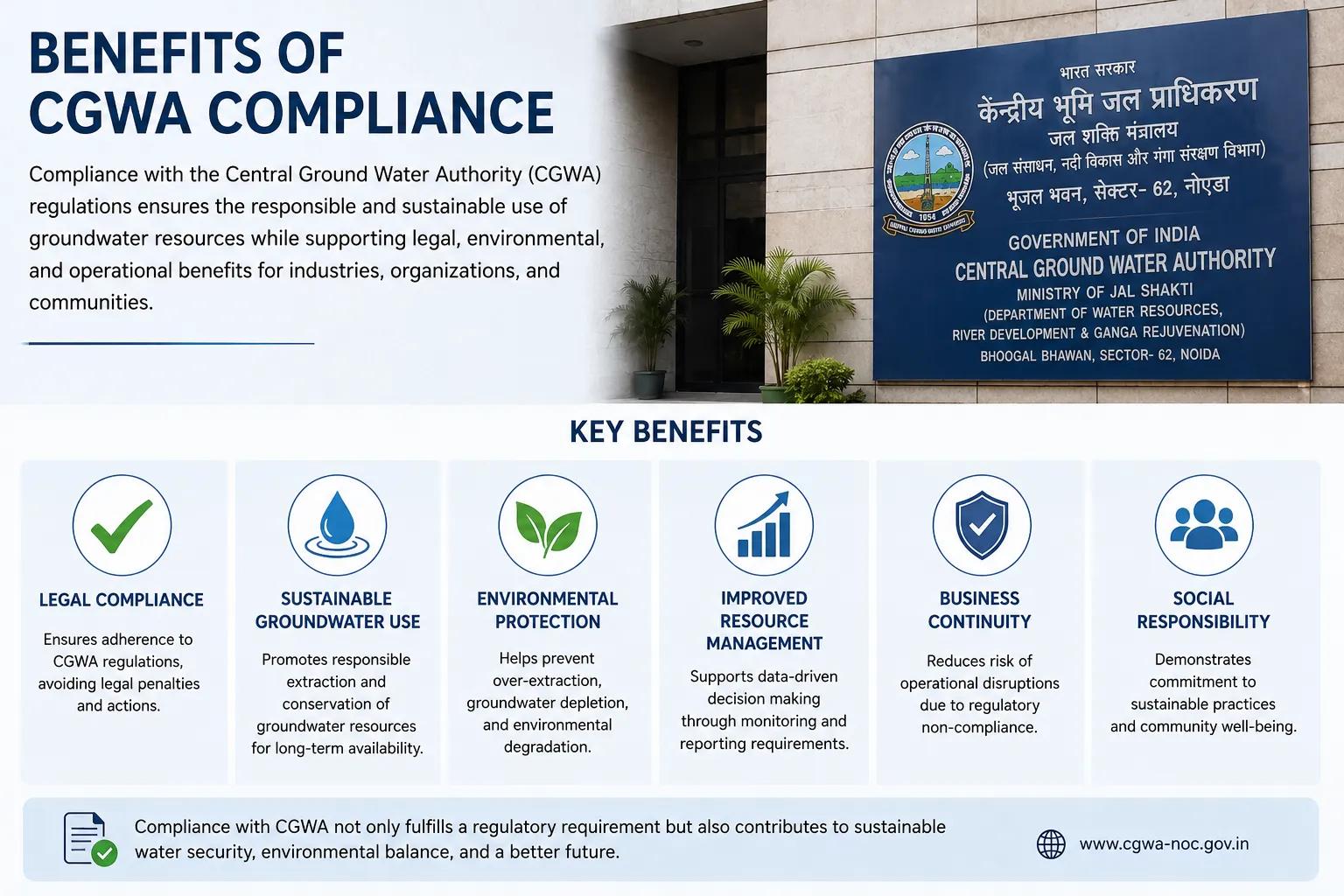
Obtaining and maintaining CGWA compliance delivers significant advantages beyond just meeting legal requirements:
- Legal groundwater extraction — operate without risk of regulatory action or project shutdown
- Environmental protection — responsible usage helps preserve aquifer health for future generations
- Sustainable resource management — data-driven extraction limits prevent over-depletion of groundwater
- Reduced regulatory risks — avoid penalties, notices, and delays that non-compliance brings
- Improved project approvals — CGWA NOC is increasingly required alongside environmental clearances and building permissions
For industries and infrastructure developers, CGWA compliance is not a bureaucratic hurdle — it is a demonstration of responsible water stewardship.
Why Choose Bhoojal Survey
Bhoojal Survey is a trusted professional groundwater consultancy providing end-to-end CGWA compliance support across India. Our services include:
- Experienced hydrogeologists and groundwater regulatory consultants
- Advanced hydrogeological investigation using scientific geophysical survey methods
- Complete CGWA NOC documentation preparation and submission support
- Rapid hydrogeological assessment reports aligned with CGWA technical requirements
- Pan-India groundwater consultancy services covering all states and union territories
- Customized groundwater approval solutions for industries, infrastructure, and real estate projects
We understand the technical and regulatory requirements of CGWA approvals — and we help clients navigate the process efficiently, accurately, and with full compliance.
Conclusion
The CGWA full form — Central Ground Water Authority — represents India's primary legal framework for protecting and regulating one of its most critical natural resources. Whether you are an industry owner, infrastructure developer, or project manager, understanding CGWA and securing the correct approvals is non-negotiable.
Scientific hydrogeological investigation, accurate documentation, and professional consultancy support are what make the difference between a smooth approval and a prolonged regulatory process.
Contact Bhoojal Survey today for expert CGWA NOC support, hydrogeological assessment, and groundwater compliance consultancy services anywhere in India.
Frequently Asked Questions (FAQs)
Q1. What is the full form of CGWA? CGWA full form is Central Ground Water Authority. It is India's statutory body responsible for regulating groundwater extraction and granting NOC approvals under the Environment (Protection) Act, 1986.
Q2. What is the role of CGWA in India? CGWA regulates groundwater abstraction, designates over-exploited and stressed groundwater zones, issues NOC approvals, enforces compliance, and promotes sustainable groundwater management across India.
Q3. Who requires CGWA approval? Industries, infrastructure developers, mining companies, commercial establishments, and any entity extracting groundwater above permitted thresholds or operating in CGWA-notified areas must obtain CGWA NOC approval.
Q4. Is CGWA approval mandatory for groundwater extraction? Yes. In notified groundwater-stressed areas and for large-scale extraction, CGWA approval is legally mandatory. Operating without it can result in penalties, legal notices, and project suspension.
Q5. How can I apply for a CGWA NOC? A CGWA NOC application requires a detailed hydrogeological investigation report, groundwater usage justification, recharge plan, and supporting field survey data. Professional consultants like Bhoojal Survey assist with the complete application process.