
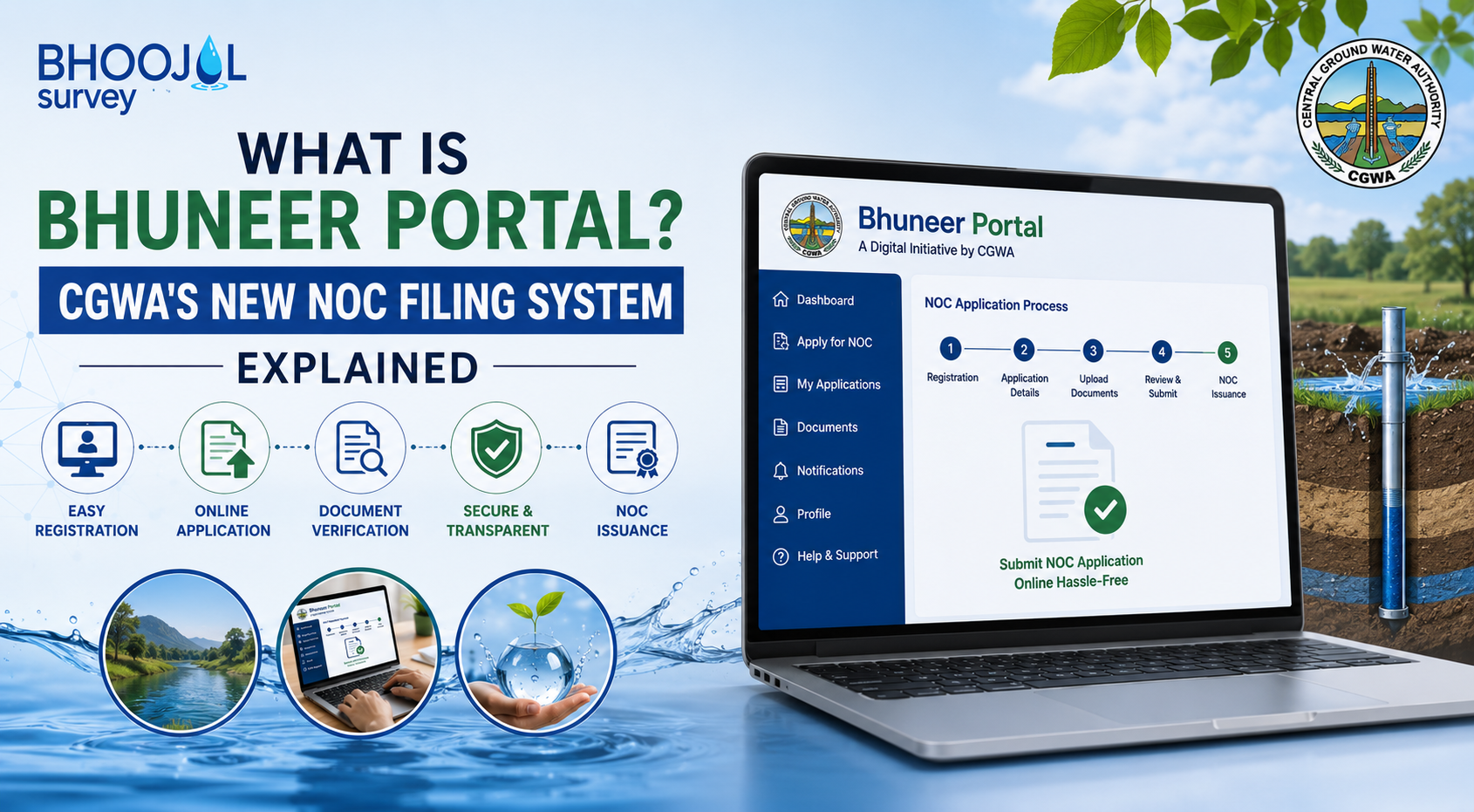
Every industry, infrastructure project, and mining operation in India that extracts groundwater above the prescribed threshold must obtain a CGWA NOC from the Central Ground Water Authority. Until late 2024, this was done through the old NOCAP portal.
That system has been retired. In its place, CGWA has launched the Bhuneer Portal - a purpose-built digital platform that handles every stage of the NOC lifecycle, from first-time registration to post-approval compliance monitoring.
The Bhuneer Portal is not simply an upgraded version of NOCAP. It is a structurally different system with new features, new compliance mechanisms, and new obligations that did not exist under the old framework.
For any project that needs a CGWA NOC in 2026, understanding what the Bhuneer Portal is - what it does, how it works, and what it requires - is the necessary starting point.
Why the Central Ground Water Authority Replaced NOCAP With Bhuneer
The old NOCAP portal served as CGWA's NOC management system for years but had fundamental limitations that the Bhuneer Portal was specifically designed to address.
NOCAP operated as a document submission and approval system. Once a CGWA NOC was issued, NOCAP had no mechanism to monitor whether the applicant was actually complying with the conditions attached - whether the rainwater harvesting structure was installed, whether extraction volumes matched the sanctioned quantity, or whether water quality monitoring was being conducted.
Compliance was largely self-reported and inconsistently enforced. NOCAP also required separate registrations for each project under the same company, creating fragmented records across industries with multiple extraction points.
The Bhuneer Portal, launched in 2024 by CGWA in collaboration with the National Informatics Centre (NIC) under the Ministry of Jal Shakti, was built to solve these problems directly.
It integrates application filing, NOC issuance, digital flow meter telemetry, monthly abstraction data uploads, and self-inspection reporting into a single platform.
The result is a shift from periodic licensing to continuous compliance monitoring - a fundamentally different regulatory model that NOCAP could not support.
The name itself reflects this purpose. "Bhu-Neer" combines the Sanskrit words for earth (Bhu) and water (Neer), positioning the portal as the central mechanism for managing India's groundwater resources rather than simply processing permit applications.
Key Features That Make the Bhuneer Portal Significantly Better
The Bhuneer Portal introduced several specific features that represent genuine improvements over the NOCAP system, each addressing a documented limitation of the old platform.
The PAN-based Single ID system is the most operationally significant change. Under NOCAP, companies registered separately for each extraction point, creating fragmented records that made compliance tracking difficult for both applicants and CGWA.
On the Bhuneer Portal, a single PAN number serves as the master identifier - all extraction structures, all NOC applications, and all compliance submissions across an organisation are managed under one registered account.
QR code-enabled digital NOCs are issued for every approval granted through the portal. Each NOC carries a unique QR code linked to the live certificate record in CGWA's central database.
Scanning the code instantly verifies whether the NOC is valid, current, and unaltered - eliminating the possibility of forged or tampered certificates and allowing any authority to perform real-time verification without contacting CGWA directly.
The Eligibility Checker is a pre-application tool that allows prospective applicants to verify whether their project falls within a notified area, what category of NOC applies to their extraction requirement, and whether they are exempt from full CGWA NOC requirements before investing time in the application process.
This feature did not exist in NOCAP and was a common source of misfiled applications.
The Online Charges Calculator estimates the water conservation fee, groundwater abstraction charges, and application processing fee before filing begins. This allows applicants to plan for the financial obligations of a CGWA NOC accurately rather than encountering unexpected charges mid-process.
The Query Module enables direct communication between applicants and CGWA officials through the portal, with a tracked record of all exchanges.
Under NOCAP, queries and responses were handled through email or phone, creating unstructured communication trails that caused delays and disputes. The Bhuneer query module keeps all technical correspondence attached to the specific application it concerns.
Real-time SMS and email alerts update applicants on every status change - submission confirmation, query raised, inspection scheduled, approval granted - eliminating the need to log in repeatedly to check progress.
Who Must Register on the Bhuneer Portal and Why It Is Mandatory
Every entity that requires a CGWA NOC must register on the Bhuneer Portal - there is no offline or alternative application route in 2026. The portal is the only authorised system for CGWA NOC filing, renewal, enhancement, regularisation, and compliance submission.
Industries and factories extracting more than 10 cubic metres per day of groundwater in notified areas must hold a Bhuneer NOC. Infrastructure projects - construction companies, real estate developers, townships - above the same threshold require clearance.
Mining projects must obtain a CGWA NOC regardless of extraction volume. Bulk commercial users including hospitals, hotels, educational institutions, and IT parks operating their own borewells fall under the same mandatory framework.
Small MSMEs extracting less than 10 KLD, individual domestic users, agricultural users, and residential housing societies extracting up to 20 KLD for domestic use with rainwater harvesting in place are exempt from the full CGWA NOC requirement.
However - and this is a point that many applicants overlook - exempt MSMEs must still register on the Bhuneer Portal and obtain an Exemption Certificate to formally document their exempt status.
Operating without this certificate, even below the extraction threshold, creates a compliance gap that can complicate future expansion applications or regulatory inspections.
Types of NOC Applications Handled Through the Bhuneer Portal
The Bhuneer Portal manages six distinct application types, each serving a different regulatory situation.
A Fresh NOC is filed for new groundwater extraction structures with no prior CGWA clearance history.
A Renewal NOC is filed when an existing NOC approaches its expiry date - renewal must be initiated at least 90 days before expiry to prevent a compliance gap. An Enhancement NOC is required when an existing NOC holder seeks to increase extraction beyond the previously sanctioned quantity.
A Regularisation NOC covers borewells installed without prior CGWA clearance - while regularisation is possible, it attracts environmental compensation for the unauthorised extraction period and is assessed under the same technical standards as fresh applications.
A No Extraction NOC is a formal certificate confirming zero groundwater use, required in certain project approval workflows.
An Exemption Certificate confirms that the applicant's extraction falls below mandatory NOC thresholds - required even for exempt entities to formalise their status on the portal.
How CGWA NOC Applications Are Filed and Processed on Bhuneer
The Bhuneer Portal application process begins with registration using a valid mobile number, email address, and company PAN number, all verified through OTP. After registration, a User Profile and Company Profile - capturing personal credentials and GST, PAN, and address details respectively - must be completed before the application dashboard becomes accessible.
Fresh CGWA NOC applications are initiated from the dashboard, where the applicant selects application type, enters project details, calculates the net groundwater requirement using the A minus B equals C formula, and provides borewell specifications with GPS coordinates. Supporting documents - including the hydrogeological survey report, borewell yield test data, earth resistivity test results, and rainwater harvesting structure undertaking - are uploaded in PDF format with a maximum size of 5 MB per file.
A hydrogeological survey prepared to CGWA's technical standards is the most critical document in the entire package and the primary determinant of whether the application clears technical review without revision requests. Application fees are paid through Bharatkosh.
The submitted application enters CGWA's technical review queue, with all communication tracked through the portal's query module.
Bhuneer Portal vs NOCAP: Everything That Changed for Applicants
The differences between the Bhuneer Portal and NOCAP extend beyond interface design. The table below summarises the structural changes that affect how applicants must prepare and manage their CGWA NOC engagements.
Registration: NOCAP used project-specific registrations. Bhuneer uses PAN-based single ID covering all of an organisation's projects.
NOC Certificate: NOCAP issued standard PDF certificates. Bhuneer issues QR code-enabled digital certificates with live verification capability.
Compliance Monitoring: NOCAP had no built-in compliance tracking. Bhuneer integrates digital flow meter telemetry and monthly abstraction data uploads directly into the platform.
Query Handling: NOCAP used email and phone for queries. Bhuneer has an in-portal query module with tracked communication history.
Self-Inspection: NOCAP had no self-inspection mechanism. Bhuneer requires periodic self-inspection reports uploaded directly to the applicant's account.
Exemption Certificate: NOCAP had no formal exemption process. Bhuneer requires even exempt MSMEs to obtain a formal Exemption Certificate through the portal.
For NOCAP NOC holders, the Bhuneer transition requires a mandatory data migration - entering the legacy NOC number, verifying credentials, and uploading the original certificate - before any renewal or modification application can be filed on the new system.
How the Bhuneer Portal Manages Post-Approval Compliance in 2026
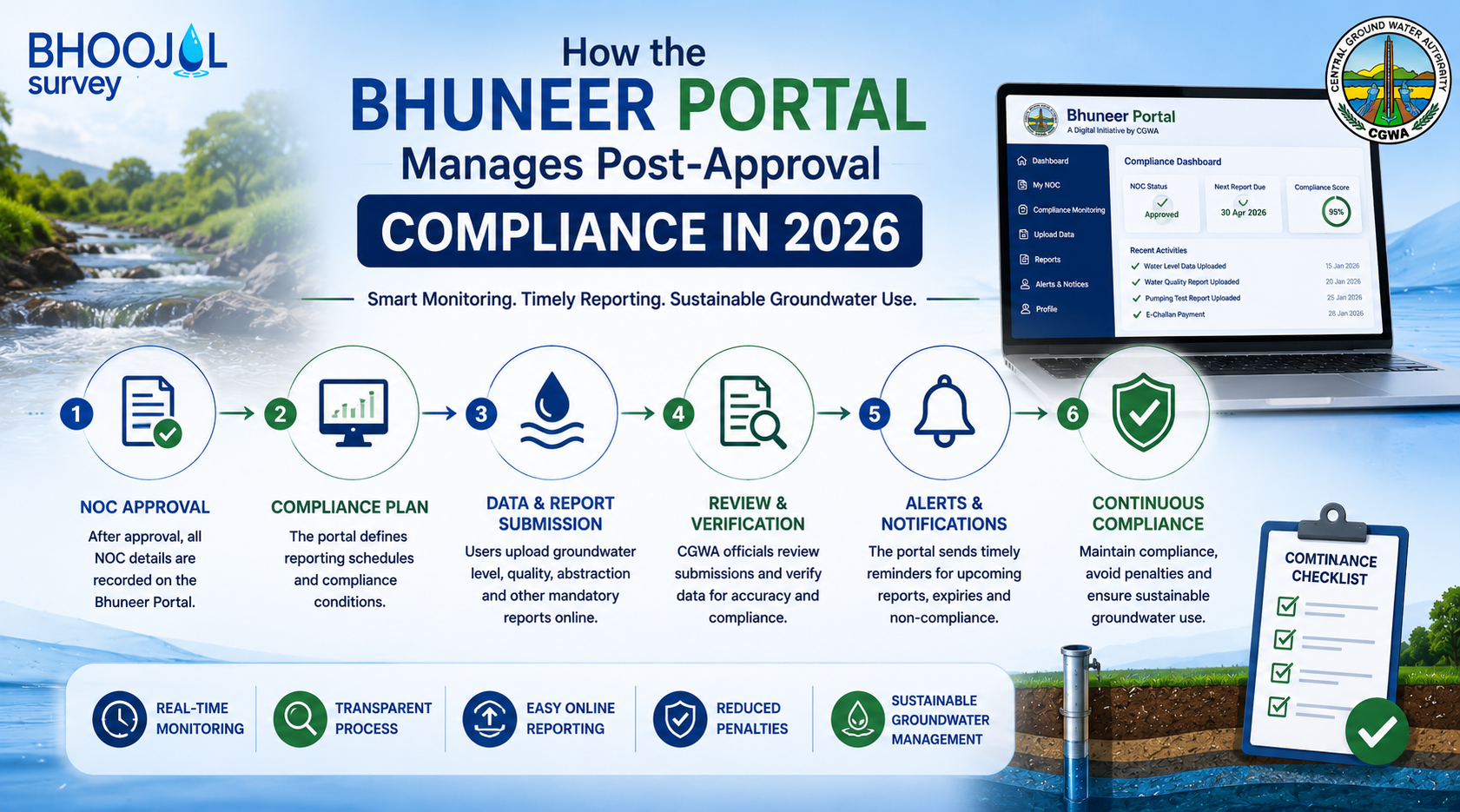
The Bhuneer Portal's most significant departure from NOCAP is its role after the NOC is granted. Under the old system, compliance monitoring was largely passive. The Bhuneer Portal makes compliance active and continuous.
Within 30 days of CGWA NOC grant, the holder must install a BIS-standard digital water flow meter with real-time telemetry on every abstraction structure and link the meter to their Bhuneer account.
Monthly abstraction data is transmitted automatically from the meter to the portal - manual data entry is not accepted for regulated users. Annual meter calibration by a NABL-accredited agency is mandatory, with calibration certificates uploaded within 7 days of issuance.
The Self-Inspection Report must be submitted periodically through the portal, covering rainwater harvesting structure status, meter functionality, STP and ETP compliance where applicable, and groundwater quality monitoring data from NABL-accredited laboratory analysis.
CGWA reviews self-inspection submissions and cross-references telemetry data against sanctioned extraction quantities in real time. Discrepancies trigger compliance alerts that can escalate to enforcement action.
Bhoojal Survey supports clients with post-NOC compliance management on the Bhuneer Portal - meter documentation, monthly data verification, self-inspection report preparation, and renewal coordination - ensuring continuous compliance through the full NOC tenure.
Bhuneer Portal URL Changes and Common Access Confusions Resolved
One of the most common practical difficulties applicants face is accessing the correct Bhuneer Portal URL. The portal has been referenced under multiple addresses since its launch, and applicants following outdated links or bookmarked addresses may arrive at inactive or redirected pages.
The official active portal is maintained under the Ministry of Jal Shakti's domain. Applicants should always navigate directly through the Ministry of Jal Shakti's official web presence or through a current reference from CGWA's official communications rather than using bookmarked links from 2024 registration guides.
The portal interface and URL have been updated since the initial Bhuneer launch, and references in early guidance documents no longer point to the active system.
If the portal loads but login credentials fail, the first step is to use the "Forgot Password" function rather than re-registering - duplicate registrations using the same PAN number are flagged by the portal and complicate the account structure.
If a company has multiple users attempting to access the same account, credentials should be coordinated through a single registered point of contact to avoid concurrent login conflicts that the portal's session management does not always resolve cleanly.
How Bhoojal Survey Helps Clients Navigate the Bhuneer Portal
Bhoojal Survey manages the complete CGWA NOC process through the Bhuneer Portal - from initial registration and profile setup through technical document preparation, application filing, query response, and post-NOC compliance management. For clients with legacy NOCAP records, the firm handles the data migration step that must precede any renewal filing on Bhuneer.
The firm's qualified hydrogeologists prepare the hydrogeological survey report and borewell yield test documentation that CGWA's technical review team scrutinises most closely, ensuring submissions are complete and field-data-supported before filing.
Bhoojal Survey has managed Bhuneer NOC applications across India's diverse geological settings - alluvial plains, Deccan basalt, hard rock terrain, and coastal aquifer formations - and is current on the portal's 2026 compliance framework, including the self-inspection reporting requirements and digital flow meter documentation obligations.
For industries and infrastructure projects beginning the CGWA NOC process through the Bhuneer Portal for the first time, Bhoojal Survey provides the technical preparation and portal expertise that converts a complex regulatory process into a managed, time-bound engagement.
Conclusion
The Bhuneer Portal is the operational reality of CGWA NOC compliance in India in 2026. It is not an upgrade to the old system - it is a replacement, with new features, new obligations, and a fundamentally different approach to post-approval compliance monitoring that did not exist under NOCAP. Every entity that extracts groundwater commercially must work within this system.
For expert support with Bhuneer Portal registration, CGWA NOC application filing, hydrogeological report preparation, NOCAP data migration, and complete post-NOC compliance management, contact Bhoojal Survey.
FAQ
Q1. What is the Bhuneer Portal?
The Bhuneer Portal is the official online platform of the Central Ground Water Authority (CGWA) for managing groundwater extraction permissions. It enables users to apply for new CGWA NOCs, renew existing approvals, request enhancements, obtain exemption certificates, submit compliance reports, and monitor groundwater usage digitally.
Q2. Is the Bhuneer Portal different from the old NOCAP portal?
Yes. The Bhuneer Portal replaced the legacy NOCAP system in 2024. Existing NOCAP login credentials cannot be used on Bhuneer. Previous NOC holders must first migrate their data by entering their old NOC number and uploading the original certificate before applying for renewals or other services.
Q3. Who needs to register on the Bhuneer Portal?
Industries, infrastructure projects, commercial establishments, mining projects, and eligible MSMEs that extract groundwater must register on the Bhuneer Portal. Even organizations exempt from obtaining a full CGWA NOC may need to register to receive an official Exemption Certificate.
Q4. Do MSMEs extracting less than 10 KLD need an Exemption Certificate?
Yes. MSMEs extracting less than 10 KLD of groundwater are generally exempt from the full CGWA NOC process but must still register on the Bhuneer Portal and obtain an official Exemption Certificate to maintain regulatory compliance.
Q5. What services can be accessed through the Bhuneer Portal?
The Bhuneer Portal allows users to submit fresh CGWA NOC applications, renew existing NOCs, apply for capacity enhancements, regularize groundwater extraction, obtain Exemption Certificates, upload digital flow meter data, submit self-inspection reports, and manage post-NOC compliance from a single platform.