

Introduction
Groundwater is one of the most critical — and often underestimated — forces acting on civil infrastructure. Whether it is a dam holding millions of litres of water, a deep mining shaft, a metro tunnel cutting beneath a city, or a highway embankment built on soft soil, understanding what groundwater is doing beneath the surface is not optional —Piezometer monitoring it is essential.
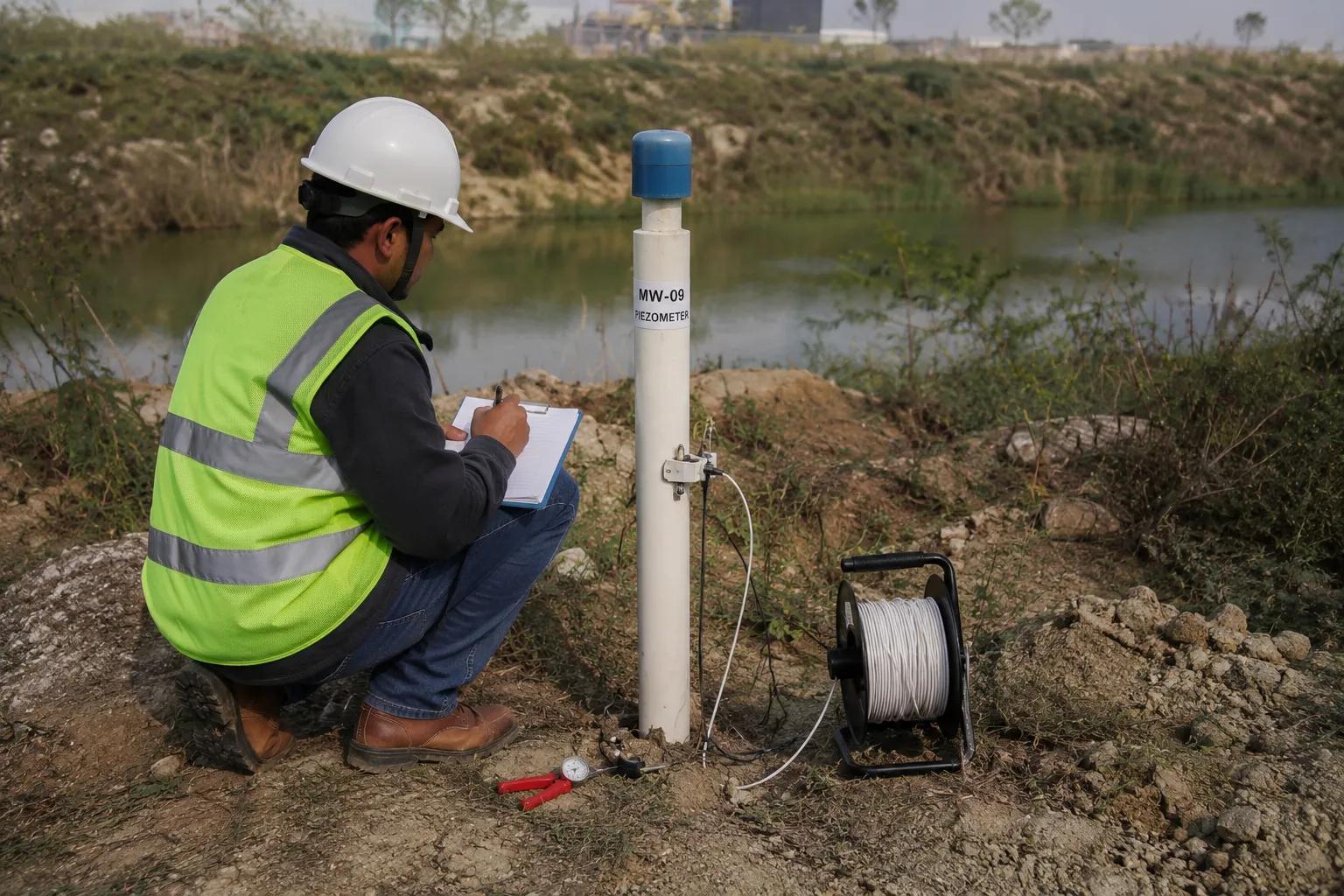
Piezometer monitoring services provide engineers, project managers, and environmental consultants with real-time, scientifically accurate data on groundwater levels and pore water pressure. A piezometer is a precision instrument installed within the ground or within a structure to continuously measure the pressure of water in soil or rock. By tracking these pressure readings over time, geotechnical teams can detect early signs of instability, verify design assumptions, and make informed decisions that protect both infrastructure and communities.
Across India, large-scale infrastructure development — highways, dams, metro rail projects, industrial complexes, and mining operations — demands consistent, reliable geotechnical monitoring. Bhoojal Survey provides professional piezometer monitoring services tailored to the specific requirements of each project, combining advanced instruments with hydrogeological expertise to deliver data you can trust.
What Are Piezometer Monitoring Services?
Piezometer monitoring services involve the systematic installation, operation, and data collection from piezometers — instruments specifically designed to measure pore water pressure and groundwater levels in soil, rock, or structural fill.
At their core, these services answer two fundamental questions that every geotechnical and hydrogeological project must address:
- Where exactly is the groundwater table, and how is it changing?
- What pressure is the water exerting on soil particles, rock formations, or structural elements?
A professional groundwater monitoring solution goes beyond simply placing instruments in the ground. It includes careful site assessment, proper piezometer installation, sensor calibration, data logging system configuration, periodic data collection, and expert technical reporting. Bhoojal Survey delivers all of these components as an integrated piezometer monitoring service, ensuring that clients receive accurate, actionable groundwater data throughout the full project lifecycle.
Why Piezometer Monitoring Is Important
The consequences of inadequate groundwater monitoring can be severe. Elevated pore water pressure within an embankment or dam foundation can trigger slope failures. Undetected rising groundwater tables can compromise excavation safety. Unexpected groundwater conditions in mining can cause tunnel collapses or equipment damage. In every case, the cost of poor monitoring far exceeds the cost of a professional monitoring programme.
Key Reasons Piezometer Monitoring Is Critical
- Continuously tracks groundwater level fluctuations during and after construction
- Measures pore water pressure in soil and rock to assess slope stability
- Ensures dam and embankment safety by detecting seepage and pressure build-up
- Provides early warning of groundwater changes that could destabilise structures
- Helps engineers verify that drainage systems are functioning as designed
- Supports environmental compliance by documenting groundwater behaviour
- Reduces risk of costly structural failures and emergency interventions
- Provides reliable data for insurance, regulatory reporting, and design validation
Applications of Piezometer Monitoring Across Industries
Professional piezometer instrumentation monitoring is deployed across a wide spectrum of industries and project types. Below are the primary sectors where Bhoojal Survey provides groundwater monitoring solutions.
Dams & Reservoirs
Dams are among the most critical piezometer monitoring applications. Monitoring pore water pressure within the dam body, foundation, and abutments allows engineers to track seepage patterns, assess embankment stability, and ensure regulatory safety requirements are consistently met.
Mining Projects
Mining operations disturb natural groundwater regimes dramatically. Piezometer data monitoring in mining helps dewater safely, predict inflows, manage slope stability in open pits, and ensure underground workings remain safe from unexpected groundwater ingress.
Highway & Bridge Construction
During road embankment construction on soft or saturated soils, pore water pressure monitoring tracks the rate of consolidation and prevents premature loading failures. Bridge foundation excavations rely on groundwater observation well monitoring to manage dewatering safely.
Metro Rail Infrastructure
Tunnelling in urban environments requires continuous geotechnical monitoring systems to detect groundwater pressure changes that could destabilise tunnel linings or cause surface settlement affecting nearby buildings.
Landfill & Environmental Sites
Landfill sites require long-term groundwater monitoring to detect leachate migration. Environmental consultants use piezometer data analysis to monitor groundwater quality trends and regulatory compliance over years or decades.
Large Construction Sites
Deep excavations for commercial buildings, infrastructure foundations, and retaining walls require careful groundwater pressure monitoring to ensure safe working conditions and protect adjacent structures.
Tunnel Construction Projects
Hydrogeological conditions in tunnel projects can change rapidly. Piezometer monitoring provides advance warning of high-pressure water zones, allowing tunnelling teams to adjust grouting and support strategies proactively.
Industrial Infrastructure
Effluent ponds, tailings storage facilities, and industrial foundations all require reliable groundwater monitoring systems to ensure long-term geotechnical integrity and environmental compliance.
Methods Used in Piezometer Monitoring
Different project conditions call for different piezometer types. Bhoojal Survey selects the most appropriate monitoring method based on site geology, required accuracy, project duration, and data reporting requirements.
Standpipe Piezometer (Casagrande Piezometer)
The standpipe piezometer is one of the oldest and most reliable groundwater monitoring instruments. It consists of a perforated piezometer tip connected to a riser pipe installed within a borehole. Water enters the tip and rises within the standpipe to a level that reflects the actual piezometric head at that depth. Groundwater level is measured by lowering a water level indicator (dipmeter) down the standpipe.
Standpipe piezometers are cost-effective, easy to install, and require minimal electronic equipment. They are widely used for long-term groundwater observation well monitoring in dams, slopes, and environmental sites where very fast pressure response is not required.
Vibrating Wire Piezometer
The vibrating wire piezometer is the preferred instrument for high-accuracy, long-term geotechnical monitoring. It uses a steel wire tensioned across a pressure-sensitive diaphragm. As pore water pressure acts on the diaphragm, the wire tension changes, altering its vibration frequency when electrically excited. This frequency is directly proportional to the applied pressure, giving highly accurate and repeatable readings.
Vibrating wire piezometer monitoring is ideal for dam and embankment monitoring, automated data logging, and projects requiring continuous remote monitoring. Readings are unaffected by cable length or electrical resistance, making them reliable over long distances and extended project periods.
Pneumatic Piezometer
Pneumatic piezometers operate by pressurising twin tubes to balance the pore water pressure acting on a diaphragm sensor. When the applied gas pressure exactly equals the pore pressure, a valve opens and the equilibrium pressure is recorded. These instruments perform well in contaminated or corrosive groundwater environments and are commonly used in mining, industrial sites, and landfill monitoring applications.
Equipment and Instruments Used in Piezometer Monitoring
Accurate piezometer data monitoring depends entirely on the quality and calibration of the instruments deployed. Bhoojal Survey uses a comprehensive range of geotechnical monitoring sensors and data acquisition equipment.
Instruments & Equipment Used by Bhoojal Survey
- Vibrating wire piezometers (high accuracy)✔ Geotechnical monitoring sensors
- Standpipe piezometers (Casagrande type)✔ Field monitoring equipment & accessories
- SSRMPATS Instrument for hydrogeological
- Pneumatic piezometer sensorssurvey
- Data loggers (automatic data acquisition)✔ GER DETECT ground investigation equipment
- Portable dipmeter / water level indicators✔ PQWT groundwater detection instruments
- Multi-channel data acquisition systems✔ Real-time telemetry & remote monitoring systems
For site investigation supporting piezometer installation, Bhoojal Survey conducts hydrogeological surveys using the SSRMPATS Instrument, GER DETECT, and PQWT at site for open well and borewell location identification — ensuring piezometers are installed at hydrologically optimal depths and locations for maximum data reliability.
Factors Affecting Piezometer Monitoring Accuracy
Even the best instruments can produce unreliable data if key field and operational factors are not carefully managed. Bhoojal Survey's monitoring protocols address each of the following variables:
- Installation depth and location: Piezometers must be installed at the correct depth relative to thetarget groundwater zone. Incorrect placement leads to misleading pressure readings.
- Soil and geological conditions: Highly permeable soils respond quickly to pressure changes, whilelow-permeability clays may show delayed responses. Geological context is essential for correct data interpretation.
- Instrument calibration: All sensors must be factory-calibrated and field-verified before installation.
Calibration certificates are maintained and sensors are recalibrated at defined intervals.
- Data logging accuracy: Data loggers must be set to appropriate measurement intervals.
Too-infrequent logging may miss rapid pressure events; too-frequent logging creates unnecessarily large datasets.
- Environmental conditions: Temperature fluctuations can affect sensor readings. Vibrating wirepiezometers include temperature sensors to allow thermal correction of pressure data.
- Monitoring frequency and continuity: Irregular monitoring schedules can create gaps in the datasetthat make trend analysis unreliable. Automated data loggers eliminate this risk.
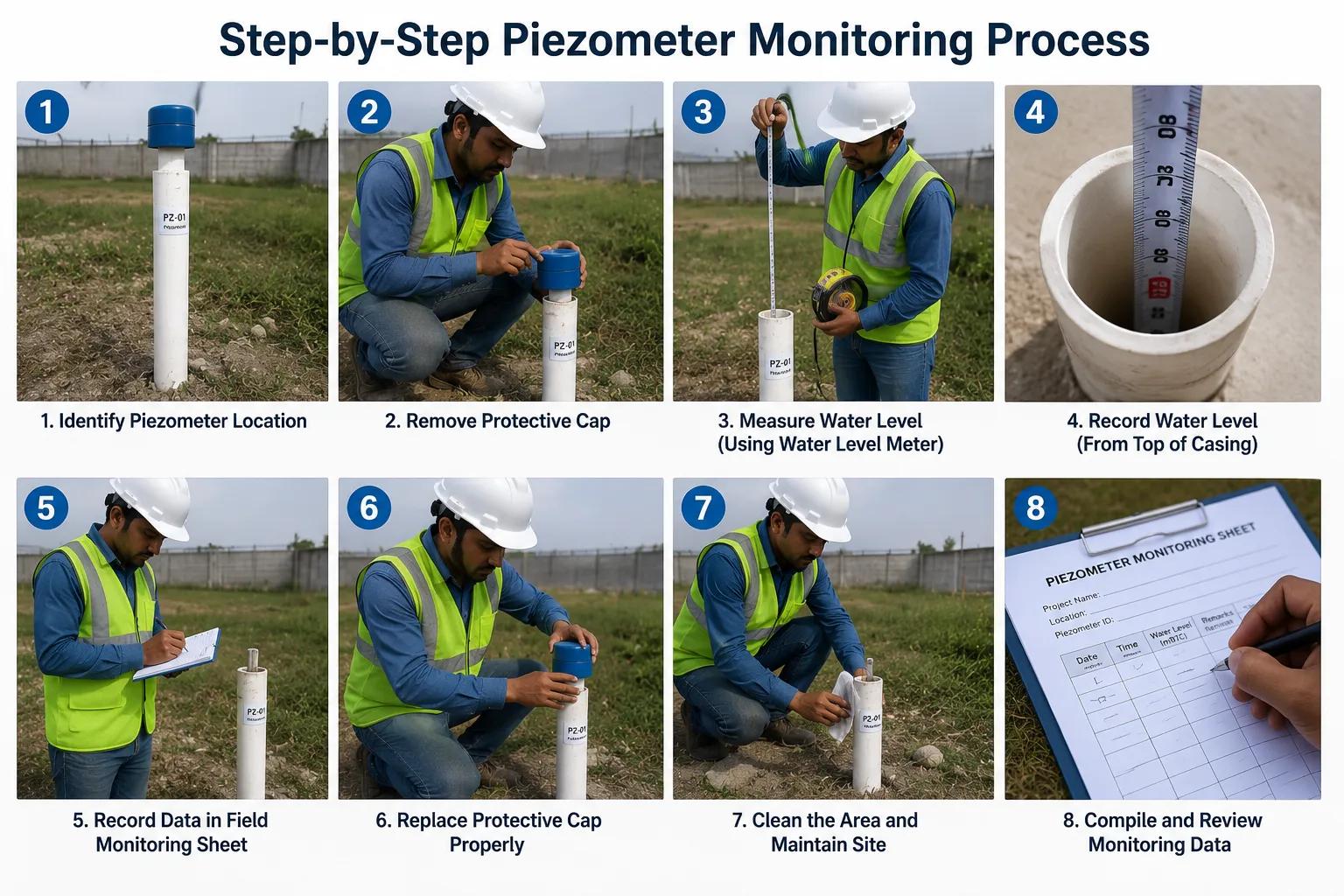
Step-by-Step Piezometer Monitoring Process
Bhoojal Survey follows a structured, quality-assured monitoring workflow on every project:
Step
01 Site Inspection & Geotechnical
Assessment
Review existing borehole logs, soil reports, and geological maps; conduct walkover survey
02 Monitoring Requirement Analysis
Define monitoring objectives, target zones, required accuracy, and reporting frequency
03 Piezometer Installation Planning
Select piezometer type, determine installation depths, prepare installation drawings
04 Borehole Drilling & Preparation
Drill boreholes to specified depths; flush and stabilise before installation
05 Sensor Placement & Grouting
Install piezometer at correct depth; backfill and grout borehole per specification
06 Calibration & Baseline Reading
Record initial readings; verify sensor output against known reference conditions
07 Data Logging System Setup
Connect and programme data loggers; configure
sampling intervals and alert thresholds
08 Ongoing Groundwater Monitoring
Collect readings at defined frequency; download data from loggers periodically
09 Data Analysis & Interpretation
Process piezometric data; identify trends, anomalies, and pressure events
10 Technical Report Preparation
Deliver detailed monitoring report with graphs, interpretation, and recommendations
Benefits of Professional Piezometer Monitoring Services
Investing in professional groundwater monitoring services delivers measurable returns across project safety, cost efficiency, and regulatory compliance.
Key Benefits Delivered by Bhoojal Survey
- Accurate, real-time groundwater level and pressure data from calibrated instruments
- Early warning of adverse pressure build-up before instability develops
- Improved infrastructure safety for dams, embankments, tunnels, and deep excavations
- Better construction planning through data-driven understanding of groundwater behaviour
- Long-term geotechnical monitoring records for regulatory submission and design review
- Reduced project risk and lower insurance premiums through demonstrated monitoring compliance
- Expert data interpretation that converts raw sensor readings into actionable engineering insight
How Bhoojal Survey Can Help You
Bhoojal Survey is a specialised geotechnical and hydrogeological consultancy with deep experience in piezometer installation and monitoring across India. Here is how we add value to your project from day one:
End-to-End Service
From initial site assessment and borehole planning through to final monitoring reports, Bhoojal Survey manages the complete piezometer monitoring programme — so your team can focus on construction and delivery.
Expert Instrument Selection
Not every project needs the same piezometer type. Our hydrogeologists analyse your site conditions, project timeline, and monitoring objectives to recommend the most cost-effective and accurate instrument for the job.
Rapid Mobilisation Across India
With field teams experienced in pan-India project deployment, Bhoojal Survey can mobilise quickly to remote dam sites, urban metro corridors, or active mining operations — wherever your project is.
Customised Monitoring Frequencies
We design monitoring schedules around your construction programme. During critical construction phases — embankment raising, dewatering, or tunnel breakthrough — we increase monitoring frequency to provide maximum safety assurance.
Clear, Actionable Technical Reporting
Our monitoring reports are written for engineers, not just data analysts. Every report includes trend graphs, anomaly identification, risk assessment, and clear recommendations — so project decisions are always based on solid evidence.
Advanced Hydrogeological Survey Integration
For new projects, Bhoojal Survey integrates piezometer monitoring with hydrogeological surveys using SSRMPATS, GER DETECT, and PQWT instruments — giving you a complete picture of groundwater conditions before and during construction.
Long-Term Monitoring Programmes
Dams, landfills, and industrial facilities require monitoring over years or even decades. Bhoojal Survey offers structured long-term piezometer data monitoring agreements with annual calibration checks, data management, and regular reporting.
Regulatory Compliance Support
Many infrastructure projects in India require documented groundwater monitoring as a condition of environmental clearance or dam safety regulations. Bhoojal Survey's reports are structured to meet these regulatory requirements, reducing compliance risk for project owners.
Why Choose Bhoojal Survey for Piezometer Monitoring Services
When it comes to groundwater pressure monitoring in critical infrastructure projects, experience, instrumentation quality, and data reliability are non-negotiable. Bhoojal Survey consistently delivers on all three.
✔ 15+ years of hydrogeological expertise
✔ Fast project mobilisation & setup
✔ Advanced vibrating wire & standpipe piezometers
✔ Detailed, engineer-ready monitoring reports
✔ Calibrated, certified monitoring instruments
✔ Customised geotechnical monitoring solutions
✔ Experienced field geotechnical teams
✔ Expertise in dams, mining, metro & highways
✔ Pan-India project deployment capability
✔ Long-term monitoring programme management
Conclusion
Piezometer monitoring is not a luxury add-on for large infrastructure projects — it is a fundamental safety and quality assurance requirement. Whether your project involves a dam, a mine, a metro rail system, or a major construction site, understanding what groundwater is doing beneath the surface is what separates well-managed projects from those that encounter costly, avoidable problems.
Bhoojal Survey brings together advanced piezometer instrumentation, experienced hydrogeological expertise, and a structured monitoring methodology to deliver groundwater monitoring data that engineers and project owners can rely on. From initial site survey through to long-term monitoring programme management, we are your trusted partner in geotechnical monitoring across India.
Contact Bhoojal Survey Today for a Free Piezometer Monitoring Consultation Call us | Email us | Visit: bhoojal.com
Frequently Asked Questions (FAQs)
Q: What is a piezometer used for?
A piezometer is used to measure pore water pressure and groundwater levels in soil, rock, or structural fill. It provides geotechnical engineers with quantitative data on groundwater conditions that are essential for assessing slope stability, dam safety, excavation safety, and long-term infrastructure performance.
Q: How does piezometer monitoring work?
Piezometers are installed within boreholes drilled to the target monitoring depth. The instrument measures the pressure of groundwater at that depth using either a standpipe water column, a vibrating wire diaphragm, or a pneumatic pressure balance. Readings are taken manually or automatically by data loggers and then analysed to determine piezometric head and pressure trends over time.
Q: Where are piezometers used?
Piezometers are used in a wide range of applications including dams and reservoirs, mining projects, highway and bridge construction, metro rail tunnelling, landfill monitoring, deep building excavations, industrial facilities, and environmental groundwater monitoring programmes.
Q: Why is piezometer monitoring important in dams?
Dam safety depends heavily on controlling pore water pressure within the embankment and foundation. If pore water pressure rises unexpectedly — due to seepage, heavy rainfall, or rapid reservoir filling — it can reduce the effective stress in the soil and trigger slope instability or piping failure. Piezometer monitoring provides continuous data that allows dam operators to detect these dangerous conditions early and take preventive action.
Q: What is pore water pressure monitoring?
Pore water pressure monitoring is the measurement of the pressure exerted by water within the voids of soil or rock. This pressure directly affects the shear strength of the ground. High pore water pressure reduces effective stress, weakening soil and increasing the risk of failure. Piezometers measure this pressure accurately, providing critical input data for slope stability analyses and dam safety assessments.
Q: How often should piezometer monitoring be done?
Monitoring frequency depends on the project stage and risk level. During active construction, embankment raising, or rapid groundwater changes, daily or even continuous automated monitoring may be required. During stable operational phases, weekly or monthly manual readings may be sufficient. Bhoojal Survey designs monitoring schedules appropriate to each project's specific risk profile.
Q: What types of piezometers does Bhoojal Survey install?
Bhoojal Survey installs standpipe (Casagrande) piezometers, vibrating wire piezometers, and pneumatic piezometers — selecting the most appropriate type based on soil conditions, required measurement accuracy, project duration, and data acquisition requirements.
Q: Can Bhoojal Survey provide long-term groundwater monitoring?
Yes. Bhoojal Survey offers structured long-term piezometer monitoring programmes for dams, landfills, industrial facilities, and other infrastructure requiring extended monitoring. These programmes include scheduled field visits, data logger downloads, annual calibration checks, and regular technical reporting to meet regulatory and safety requirements.