
Every CGWA NOC carries an expiry date. When that date passes without a valid renewal in place, every litre of groundwater extracted after expiry becomes legally unauthorised - and the Central Ground Water Authority levies environmental compensation for the entire period of lapsed operation, even when the renewal is eventually approved. For industries, infrastructure projects, and commercial establishments that depend on groundwater, CGWA NOC renewal is not an administrative formality to be addressed at the last moment. It is a compliance deadline that requires preparation starting months in advance.
In 2026, the CGWA NOC renewal process runs entirely through the Bhuneer Portal - the new digital platform that replaced the legacy NOCAP system. The renewal workflow on Bhuneer is more structured, more document-intensive, and more compliance-focused than what NOCAP required. Understanding the complete process - including the mandatory NOCAP data migration that must precede renewal filing - is essential before beginning any renewal application.
Why CGWA NOC Renewal Must Be Filed Before the 90-Day Deadline
CGWA's guidelines are unambiguous on this point: the CGWA NOC renewal application must be submitted at least 90 days before the expiry date of the current NOC. This is not a courtesy recommendation - it is an operational requirement built into the Bhuneer Portal's compliance tracking system.
The 90-day window exists because renewal applications go through the same technical review process as fresh applications. CGWA may raise queries, request updated field data, or order a site inspection before approving renewal. If filing happens within 30 or 60 days of expiry, even a straightforward renewal may not complete processing before the NOC lapses.
An NOC that lapses before renewal is granted - even by a single day - triggers environmental compensation charges from the date of expiry. These charges are assessed at a rate per kilolitre of extraction for the entire lapsed period, and must be cleared before the renewed NOC is issued. Early filing eliminates this risk entirely.
What Is Different in CGWA NOC Renewal vs a Fresh Application
A CGWA NOC renewal is not simply a repeat of the original fresh application. The differences are significant and directly affect what documents must be prepared and what compliance conditions must be demonstrated.
In a fresh application, the hydrogeological report establishes baseline aquifer conditions and estimates sustainable yield for a proposed extraction structure. In a renewal, the updated hydrogeological report or Impact Assessment Report must demonstrate how the aquifer has responded to actual extraction over the NOC period - whether water levels have declined, whether yield has changed, and whether the originally sanctioned extraction quantity remains sustainable.
This is a technically more demanding document because it must reconcile field data from the period of extraction with the predictions made in the original report.
A fresh application carries no prior compliance history. A renewal is assessed against whether the applicant met every condition attached to the original NOC - rainwater harvesting structure installation and maintenance, digital flow meter installation with real-time telemetry, monthly meter data uploads, groundwater quality monitoring, and payment of water conservation charges.
Non-compliance with any original NOC condition is identified during renewal review and can result in the renewal being held, reduced in extraction quantity, or denied entirely.
NOCAP to Bhuneer Migration: The First Step Before Filing Renewal
The single most common cause of renewal delay in 2026 is applicants attempting to file renewal on the Bhuneer Portal without first completing the mandatory NOCAP data migration. If your current CGWA NOC was issued under the legacy NOCAP system - which covers virtually all NOCs issued before late 2024 - your record does not automatically exist in Bhuneer. The portal will not allow a renewal application to proceed until the old record is migrated.
The migration process begins by logging into the Bhuneer Portal and navigating to the Renewal section on the dashboard. Select "Import Application from NOCAP" and enter your legacy NOCAP NOC number.
The portal retrieves the linked record and displays partially masked applicant details - verify these match your registered credentials. Confirm your registered email ID and mobile number, then upload a copy of the original NOCAP-issued NOC certificate to finalise the data linking. Once this step is confirmed, the renewal application form becomes accessible on your dashboard.
This migration must be completed even if your NOC is not yet due for renewal. Initiating it well ahead of the 90-day filing deadline is strongly recommended, as credential mismatches or certificate upload issues can add days to the process.
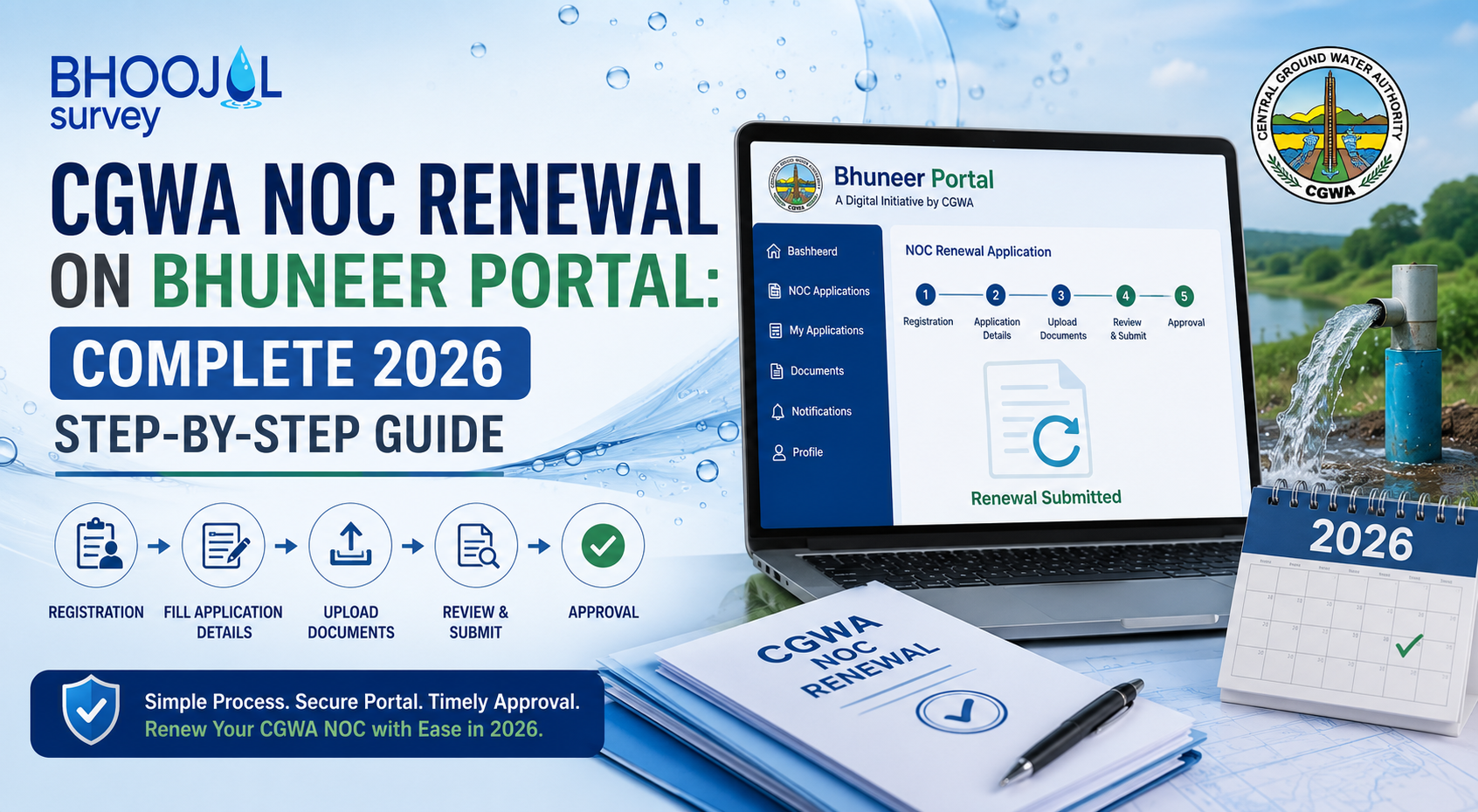
Full Step-by-Step CGWA NOC Renewal Process on Bhuneer Portal
After NOCAP migration is complete, the renewal application proceeds through a defined sequence of steps on the Bhuneer Portal.
The applicant logs in and selects the renewal application from the dashboard. The project details section - company information, GST and PAN, project type, and site location - is pre-populated from the migrated NOCAP record but must be reviewed and updated where details have changed.
The water requirement calculation must be reconfirmed or revised: Total Requirement (A) minus Water from Other Sources (B) equals Net Groundwater Requirement (C).
If extraction requirements have changed since the original NOC, this is where enhancement or reduction must be declared. Any increase in extraction quantity triggers the same technical scrutiny applied to an Enhancement NOC application.
Abstraction structure details - borewell depth, casing specifications, pump capacity, and GPS coordinates - must be verified and updated. If any structure has become defunct during the NOC period, this must be declared along with confirmation that the defunct structure has been properly sealed as per CGWA's prescribed procedure.
The Self-Compliance Report is submitted in a dedicated section, covering all original NOC conditions with documentary evidence. After completing the form and uploading all supporting documents, the renewal fee - which varies by usage category and assessment unit classification - is paid through the Bharatkosh payment gateway. The application is then formally submitted and enters CGWA's technical review queue.
Documents Required for CGWA NOC Renewal: Full 2026 Checklist
Document quality determines renewal outcome as directly as it determines fresh application outcome. A renewal submission with gaps in compliance documentation or an inadequate updated hydrogeological report will generate technical queries that extend processing time.
The updated hydrogeological survey or Impact Assessment Report is the most critical document. It must present actual field data from the NOC period - post-monsoon and pre-monsoon water table readings from observation wells, analysis of drawdown trends under actual extraction conditions, and a revised assessment of sustainable yield.
For a detailed understanding of what field investigation a technically sound hydrogeological survey must cover to satisfy CGWA's renewal review criteria, professional field investigation at the site is the only compliant approach.
The Self-Compliance Report is the second most scrutinised document - it is discussed in full in the following section. Additional mandatory documents include the Water Audit Report for applicants extracting 100 KLD or more, valid Consent to Operate (CTO) from the State Pollution Control Board, photographs and structural details of all rainwater harvesting structures with confirmation of functional status, digital flow meter installation certificate with the latest calibration report from a NABL-accredited agency, telemetry system functionality confirmation showing that monthly data uploads are active on the Bhuneer Portal, groundwater quality test reports from a NABL-accredited laboratory for samples collected during April or May of the current year, STP and ETP compliance certificates where applicable, and land ownership or updated lease documents if any changes have occurred since the original NOC.
Self-Compliance Report: The Most Critical CGWA Renewal Document
The Self-Compliance Report is a new requirement introduced with the Bhuneer portal framework and represents the single most significant difference between NOCAP-era renewal and the current process.
It is a structured declaration by the applicant confirming compliance with every condition attached to the original NOC, supported by documentary evidence for each condition.
The report covers the functional status and maintenance history of rainwater harvesting structures, with photographs dated within the last 90 days. It covers digital flow meter installation details - meter make, model, BIS certification, date of installation, and confirmation that the telemetry system is transmitting monthly data to the Bhuneer Portal.
It covers groundwater quality monitoring records, water conservation charge payment receipts, piezometer installation details for applicants extracting 10 KLD or more, and STP or ETP operational status for applicable facilities.
Any condition from the original NOC that cannot be demonstrated as compliant in the Self-Compliance Report will be flagged by CGWA's technical reviewer.
Depending on the nature of the non-compliance, CGWA may impose additional conditions, reduce the sanctioned extraction quantity, require rectification before renewal is granted, or in cases of material non-compliance, decline renewal.
Bhoojal Survey prepares Self-Compliance Reports systematically, verifying each original NOC condition against available documentation and identifying compliance gaps before submission so they can be addressed rather than flagged during review.
What Happens If Your CGWA NOC Expires Before Renewal Is Filed
An expired CGWA NOC does not mean the right to extract groundwater is permanently lost. CGWA permits renewal applications to be filed after expiry, but with significant financial and procedural consequences.
Environmental compensation is levied on the quantity of groundwater extracted from the date of NOC expiry to the date the renewed NOC is granted.
These charges accumulate daily and must be fully cleared before the renewed NOC is issued. For high-volume users, the total compensation can be substantial - particularly if the lapse period extends over several months while the renewal application works through the review process.
The compensation calculation is based on the sanctioned extraction quantity in the expired NOC and the applicable rate for the assessment unit, regardless of whether actual extraction was at, above, or below the sanctioned level.
Filing before the 90-day deadline eliminates compensation exposure entirely. For applicants already past expiry, the priority is to file renewal immediately - every day of delay increases the compensation liability. Bhoojal Survey has managed renewal filings for clients across a range of lapse scenarios, preparing technically complete submissions that move through CGWA's review process as quickly as possible to minimise the compensation period.
How Bhoojal Survey Handles CGWA NOC Renewal from Start to Finish
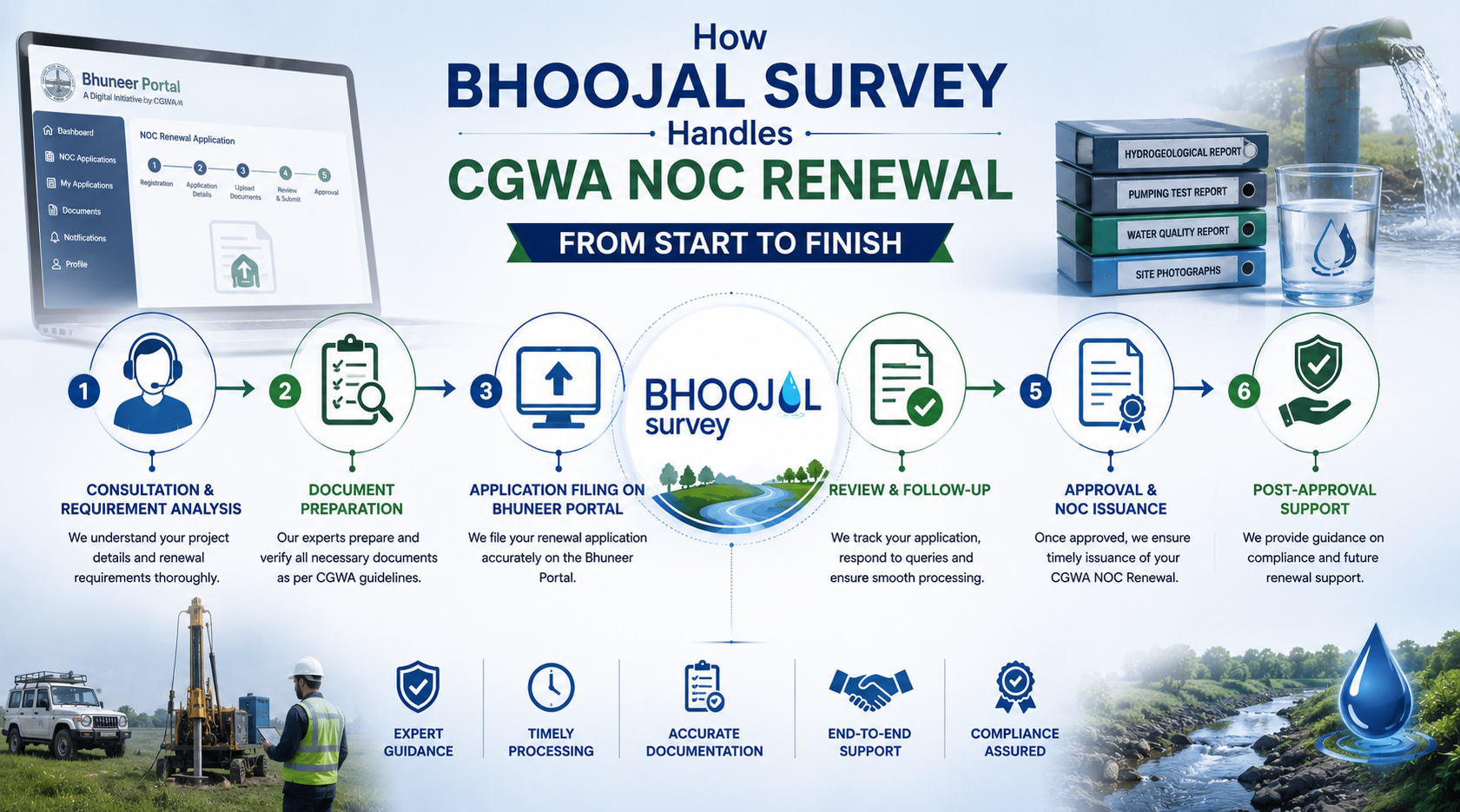
Bhoojal Survey manages the complete CGWA NOC renewal process - from initial compliance audit through NOCAP data migration, document preparation, Bhuneer portal filing, and CGWA query response - as a single coordinated engagement.
The process begins with a compliance review of the original NOC conditions against the applicant's current status, identifying any gaps in rainwater harvesting documentation, digital flow meter records, water quality monitoring data, or STP compliance that must be addressed before filing.
The firm's qualified hydrogeologists conduct the updated site investigation required for the hydrogeological Impact Assessment Report, collecting current water table data from observation wells and analysing extraction impact over the NOC period.
Bhoojal Survey prepares the Self-Compliance Report, gathers all supporting documentation, manages the NOCAP data migration, completes the Bhuneer renewal application form, and submits the complete package. Post-submission, the firm tracks the application, responds to CGWA queries, and coordinates any site inspection ordered during technical review.
Why Bhoojal Survey Is the Right Choice for CGWA NOC Renewal
Bhoojal Survey has delivered CGWA NOC renewal consultancy to hundreds of clients across industries, infrastructure projects, and mining operations in India.
The firm's direct experience with the Bhuneer portal's renewal workflow - including the NOCAP migration procedure, the Self-Compliance Report framework, and the updated hydrogeological assessment requirements - means the firm operates within the current system rather than adapting old approaches to a new platform.
In-house hydrogeological field investigation capability means Bhoojal Survey does not depend on third-party data for the most critical renewal document.
Owned geophysical equipment - electrical resistivity meters, yield test rigs, and monitoring instruments - ensures field data quality and consistency between site investigation findings and the technical conclusions of the Impact Assessment Report.
Every renewal submission prepared by Bhoojal Survey is technically complete before filing, eliminating the revision cycles that add months to renewal timelines.
Conclusion
CGWA NOC renewal is a technically demanding process that requires preparation well before the 90-day filing deadline - updated field investigation, a complete Self-Compliance Report, NOCAP data migration, and accurate Bhuneer portal filing. Getting it right protects continuous operational compliance and eliminates environmental compensation liability that lapsed NOCs create.
For expert CGWA NOC renewal services - compliance audit, updated hydrogeological assessment, NOCAP migration, Self-Compliance Report preparation, and complete Bhuneer portal management - contact Bhoojal Survey.
FAQ
Q1. When should I apply for CGWA NOC renewal?
It is recommended to apply before your existing CGWA NOC expires. Filing the renewal application early helps avoid compliance issues, penalties, and interruptions to groundwater extraction permissions.
Q2. Can I change my groundwater extraction quantity during CGWA NOC renewal?
Yes. Renewal allows you to revise your sanctioned extraction quantity. Any increase must be supported by updated hydrogeological data and is evaluated as an enhancement request, while a decrease can be declared without additional technical justification.
Q3. Is an updated hydrogeological survey mandatory for CGWA NOC renewal?
Yes. An updated hydrogeological or Impact Assessment Report is mandatory. The report must include groundwater monitoring data, such as water table trends and drawdown measurements collected during the validity of the existing NOC.
Q4. What is the CGWA NOC renewal fee on the Bhuneer portal?
The renewal fee depends on the applicant category, groundwater extraction purpose, and the assessment unit where the project is located. Additional groundwater abstraction charges or environmental compensation may also apply if applicable.
Q5. What documents are required for CGWA NOC renewal?
Common documents include the existing CGWA NOC, updated hydrogeological or Impact Assessment Report, groundwater monitoring data, water audit details, rainwater harvesting compliance, and other supporting documents required on the Bhuneer portal.