
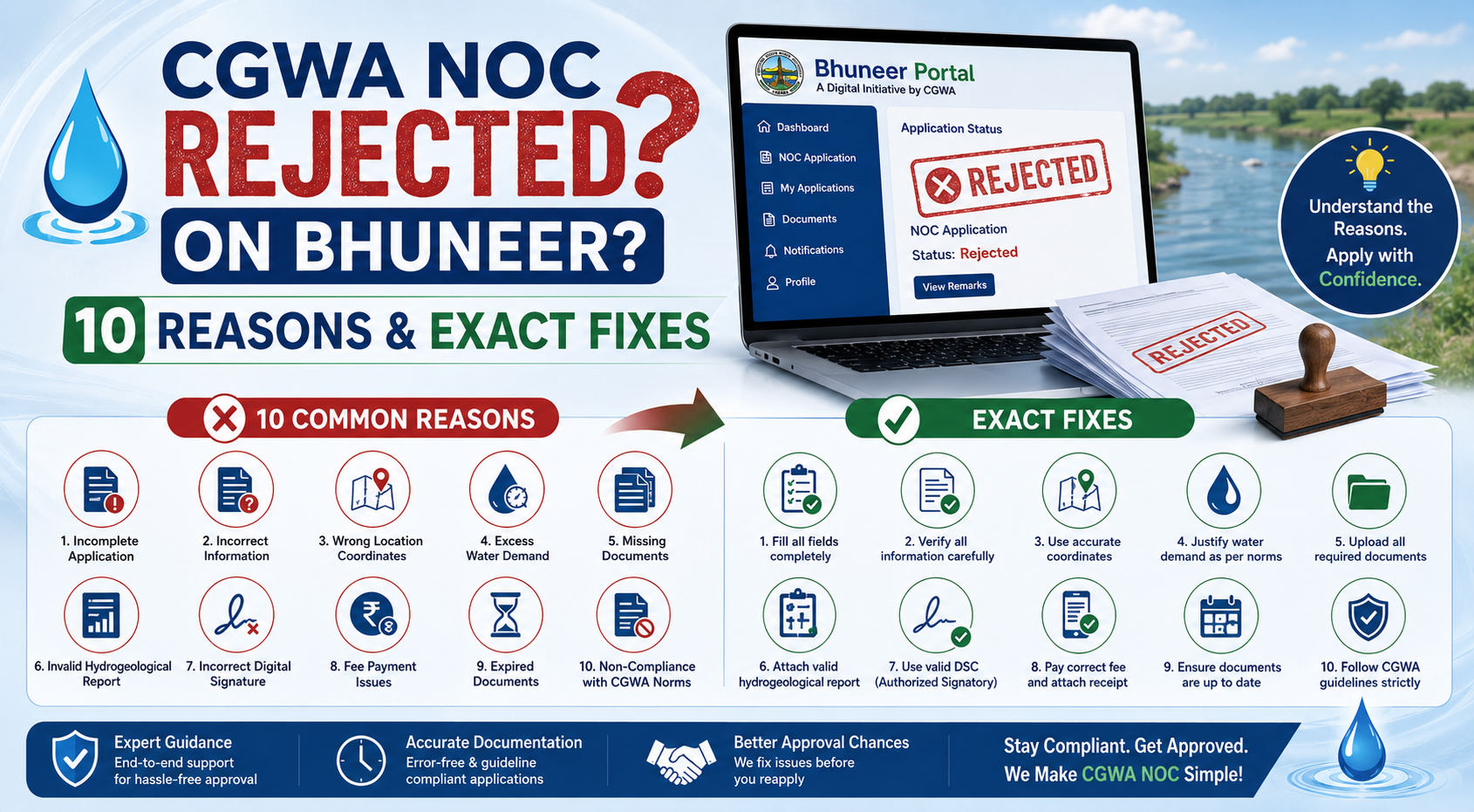
Your CGWA NOC application has been returned or rejected on the Bhuneer Portal. Before refiling, you need to know precisely why it failed -because resubmitting the same application with the same errors restarts a 45 to 90 working day review clock while your project remains non-compliant.
Every day of delay after rejection carries consequences: if you were extracting groundwater under a lapsed or rejected NOC, you are liable for environmental compensation charges, fines of ₹1 lakh to ₹5 lakh under the Environment (Protection) Act, 1986, and disconnection of electricity supply to the abstraction structure.
The Bhuneer Portal conducts a two-stage review -a portal-level validation that checks coordinates, document formats, and mandatory fields, followed by a technical review by CGWA's scientific staff who examine the hydrogeological report, yield data, and compliance documentation in detail.
Rejection can happen at either stage. Understanding which stage caused the failure, and what the exact fix is, determines how fast you can get back on track.
The ten reasons below account for the majority of CGWA NOC rejections and returns on the Bhuneer Portal in 2026.
Why Rejection Rate on CGWA Bhuneer Portal Is So High in 2026
The Bhuneer Portal has made CGWA NOC processing faster and more transparent -but it has also made technical review more rigorous. CGWA's reviewers now cross-reference GPS coordinates against notified area databases automatically, flag hydrogeological reports without site-specific field measurements at the document scanning stage, and check digital flow meter telemetry compliance through the portal's live data feeds.
The margin for filing error is significantly narrower than it was under the old NOCAP system.
The consequences of rejection are not just delays. Under the 2026 CGWA framework, operating a borewell without a valid NOC -including during a rejection and refiling period -attracts environmental compensation charges calculated per kilolitre of extraction for the entire unauthorised period.
False reporting or failure to submit water audit reports attracts a penalty of ₹10,000 per day. Failure to implement rainwater harvesting structures can lead to NOC cancellation. Getting the application right on first submission is not just more convenient -it is significantly cheaper.
Bhoojal Survey, a CGWA-accredited and ISO 9001:2015 certified firm with over 1,000 successful NOC approvals across all 18 CGWA-regulated states since 2013, reviews every application against the ten failure points below before filing.
Reason 1: Hydrogeological Report That Does Not Meet CGWA Standards
The hydrogeological report is the most common reason CGWA NOC applications are rejected at technical review. CGWA requires a site-specific investigation report prepared by a qualified hydrogeologist from the CGWB's accredited list, covering aquifer identification, depth to water-bearing zones, saturated thickness, hydraulic conductivity, recharge potential, and a quantitative sustainable yield estimate derived from actual field measurements at the proposed extraction site.
Reports that present regional groundwater data without site-specific investigation, summarise published CGWB maps without original field work, or draw yield conclusions not supported by the measured data presented are rejected at technical review.
Crucially, CGWB requires applicants in over-exploited and high-volume categories to submit a groundwater survey report from a certified hydrogeologist as a standalone mandatory document -not as part of a general EIA or project report.
A properly conducted hydrogeological survey generates the aquifer parameter data, VES resistivity measurements, and borewell yield test results that CGWA's reviewers specifically look for. The fix is conducting a fresh site-specific field investigation and rebuilding the report from that data before resubmitting.
Reason 2: Wrong or Inaccurate GPS Coordinates on Bhuneer Form
Every borewell submitted through the Bhuneer Portal must be entered with GPS coordinates in decimal degree format accurate to at least four decimal places. The portal automatically cross-references these against CGWA's notified area classification database, and a coordinate error -even a single transposed digit -triggers an automatic mismatch flag that stalls the application at portal-level validation before it reaches technical review.
The most common coordinate errors are copying latitude and longitude from a map application rather than recording them directly at the borewell site with a calibrated GPS instrument, entering DMS format values (degrees, minutes, seconds) instead of decimal degrees, and transposing latitude and longitude.
The coordinates in the form must exactly match the coordinates shown on the site location plan uploaded as a supporting document -any discrepancy between the two generates an automatic flag regardless of how small the difference is.
Record coordinates at the physical borewell location with a dedicated GPS instrument, verify the format before entry, and cross-check against the location plan before submission.
Reason 3: Water Requirement Calculation Is Incorrect or Unjustified
The Bhuneer Portal requires the net groundwater requirement to be calculated using the formula: Total Requirement (A) minus Water Availability from Other Sources (B) equals Net Groundwater Requirement (C).
CGWA's reviewers assess both the numerical accuracy of this calculation and whether each component is plausibly justified relative to the project scale and type.
A common rejection trigger is overstating component A without data-supported justification for each water use category -industrial process, domestic, greenbelt, and other uses must each be supported by technical calculations or benchmarks referenced in the application.
Understating component B by not acknowledging available surface water or municipal supply also draws scrutiny, as does claiming a higher net requirement C than the project scale credibly demands.
The reverse problem -understating C to reduce extraction fees -creates a compliance risk when actual extraction later exceeds the sanctioned quantity, which CGWA's telemetry system now detects automatically.
Calculate each component from actual project data, reference the NBC or BIS standards for domestic water requirements, and obtain a non-availability certificate from the local water supply agency before filing.
Reason 4: Documents Not in PDF Format or Exceeding 5 MB Limit
The Bhuneer Portal enforces hard technical requirements on every uploaded document: PDF format only, maximum 5 MB per file. These constraints are checked at portal-level validation before the application reaches any human reviewer.
Non-PDF files -Word documents, JPEGs, or image files -cannot be accepted by the portal's upload system. PDF files exceeding 5 MB are rejected at upload regardless of content quality.
Low-resolution scans that are difficult to read create a secondary problem at technical review -maps, VES field data sheets, and borewell specification drawings that are illegible in the uploaded PDF are flagged by reviewers as inadequate documentation even when the underlying data is technically sound.
Compress all PDFs to within the 5 MB limit using PDF compression tools before uploading, scan field documents and maps at 150 to 200 DPI for adequate legibility without excessive file size, and verify the format and size of every file before initiating the upload sequence.
Submit documents as individual files for each document type rather than combining multiple documents into a single large PDF that may exceed the size limit.
Reason 5: Rainwater Harvesting Structure Not Documented Properly
Every CGWA NOC application must include documentation confirming the installation or planned installation of a rainwater harvesting or groundwater recharge structure proportionate to the extraction quantity proposed.
For fresh applications, this requires a credible RWH design with structural specifications, not merely an undertaking. For renewal applications, it requires photographs of the existing structure dated within the previous 90 days, dimensional and capacity details, and a functional status confirmation.
CGWA's 2026 guidelines require RWH structures to comply with the updated Model Building Bye Laws specifications.
For industrial units, polluting industries must store harvested rainwater in surface tanks rather than injecting it into the aquifer -an important distinction that many applicants get wrong in the RWH design submitted with the application.
Renewal applications where photographs show a structure in disrepair, reduced capacity, or non-functional condition are returned for RWH rectification before renewal can proceed.
Inspect the structure's condition and arrange maintenance before initiating renewal filing, photograph it within 90 days of the planned submission date, and verify the design specifications against the current bye-law requirements before uploading.
Reason 6: Digital Flow Meter and Telemetry Proof Not Submitted
Under the 2026 CGWA NOC framework, a BIS-standard digital water flow meter with real-time telemetry must be installed on every groundwater abstraction structure within 30 days of NOC grant.
For renewal applications, proof of meter installation, active telemetry transmission to CGWA's servers, and the latest annual calibration certificate from a NABL-accredited agency are mandatory documents. Renewal submissions without all three of these proofs are returned as incomplete regardless of the quality of all other documentation.
New applicants must submit a digital water flow meter installation plan with telemetry specifications as part of the fresh application -this is a new mandatory document in the 2026 CGWA framework that did not exist under NOCAP-era submissions.
Renewal applicants who have not installed meters since their original NOC was granted must install and commission the meter, activate telemetry, and obtain the NABL calibration certificate before filing renewal.
The entire meter commissioning process takes 2 to 4 weeks when managed proactively -attempting renewal without completing it first adds the same delay on top of a rejection that was entirely avoidable.
Reason 7: Application in Over-Exploited Zone Without Impact Data
CGWA does not grant NOCs for new major commercial or industrial activity in over-exploited assessment units except under special government directives.
Applications from over-exploited zones receive heightened technical scrutiny -and in many cases, extraction is restricted or refused regardless of the technical merits of the application.
Applicants who file without understanding their assessment unit's classification, and without preparing the additional documentation that over-exploited zone applications require, predictably receive returns requesting impact assessment data that was missing from the original submission.
For applications in over-exploited zones that CGWA does permit -such as industrial drinking water use, small MSMEs, or projects under special government directive - the hydrogeological report must specifically address the impact of the proposed extraction on the existing over-exploitation condition, not merely establish that a productive aquifer exists at the site.
An application in an over-exploited zone that requests an extraction quantity CGWA will not sanction is returned with a reduced sanction offer -filing a realistic quantity based on pre-application guidance from a qualified consultant avoids this outcome.
Verify the assessment unit classification of the project site on CGWB's published assessment before deciding whether to file and at what quantity.
Reason 8: NOCAP to Bhuneer Migration Not Completed Before Renewal
Any entity whose current CGWA NOC was issued under the legacy NOCAP system must complete a mandatory data migration on the Bhuneer Portal before a renewal application can be filed.
This is the single most common procedural failure causing renewal delays in 2026 -applicants log in to Bhuneer and find no renewal form accessible, because the portal has no record of a NOC to renew.
The migration requires navigating to the Renewal section of the Bhuneer dashboard, selecting "Import Application from NOCAP," entering the legacy NOC number, verifying the partially displayed applicant details against registered credentials, confirming the registered email and mobile number, and uploading the original NOCAP certificate.
Only after the portal confirms successful migration does the renewal application form become accessible. Credential mismatches -where the name, mobile number, or email registered in NOCAP differs from what is registered in Bhuneer - are a common complication that delays migration.
Resolve these by verifying the original NOCAP registration details before attempting the import, and initiate the migration process at least 30 days before the 90-day renewal filing deadline.
Reason 9: Pending Portal Charges Not Cleared Before Submission
CGWA NOC applications are rejected after technical approval if required charges are not paid within the prescribed timeline -including water conservation charges, groundwater abstraction charges, and environmental compensation for any prior period of unauthorised extraction.
The Bhuneer Portal generates a charge calculation after technical review is completed, and the NOC is not issued until all charges are cleared. Applications where charges remain unpaid beyond the payment window are returned to a pending status and, if unresolved, eventually rejected.
For applicants with any history of extraction before the original NOC was obtained, or where there is a lapse period between NOC expiry and renewal grant, environmental compensation is calculated at rates published in CGWA's tables 5.4A and 5.4B and must be paid as a condition of NOC issuance.
Disputes over compensation calculations can be raised through the Bhuneer Portal's query module, but extraction cannot resume until the dispute is resolved and the NOC is issued.
Monitor the application status on the portal regularly after submission -the charge calculation notification appears as a portal alert, and missing this notification leads to unnecessary delays at the payment stage.
Reason 10: Wrong Application Type or Sub-Type Filed on Bhuneer
The Bhuneer Portal requires applicants to select the correct application type -Fresh, Renewal, Enhancement, Regularisation, No Extraction, or Exemption Certificate -and the correct sub-type within that category matching the project sector.
Selecting the wrong type causes the application to be processed under incorrect parameters: fee calculations are wrong, required documents differ, and the technical review criteria applied do not match the actual project situation.
Mistyped applications are returned for refiling, restarting the entire processing timeline.
The most commercially damaging error is filing a Regularisation application as a Fresh NOC. Regularisation triggers environmental compensation assessment for the entire period of prior unauthorised extraction, while a Fresh NOC application does not.
Incorrectly filing as Fresh when regularisation applies is identified at technical review and returned - while filing as Regularisation when the structure is genuinely new imposes unnecessary compensation liability.
The sub-type selection -Industrial, Infrastructure, Mining, Packaged Drinking Water, or Government Water Supply -also affects the document checklist and fee schedule.
Selecting the wrong sub-type results in uploading the wrong document set, which generates a document deficiency return even when all documents required for the correct sub-type are available.
How Bhoojal Survey Ensures Zero Rejection Risk Before You File
Bhoojal Survey is a CGWA-accredited, ISO 9001:2015 certified groundwater consulting firm that has delivered over 1,000 successful CGWA NOC approvals across all 18 CGWA-regulated states and Union Territories since 2013.
Every application managed by Bhoojal Survey goes through a pre-submission review that specifically checks all ten rejection risks above before the application is filed on the Bhuneer Portal.
The firm's qualified hydrogeologists -drawn from CGWB's accredited list -conduct the site-specific field investigation that produces a hydrogeological report meeting CGWA's technical review standards.
GPS coordinates are recorded at the borewell location with calibrated equipment and verified against the Bhuneer Portal's notified area database before submission. Water requirement calculations are prepared from actual project consumption data with documented justification for every component of the A-B-C formula.
All documents are converted to compliant PDF format, compressed within the 5 MB limit, and checked for legibility before upload.
For renewal applications, Bhoojal Survey completes the NOCAP data migration, verifies RWH structure condition, confirms digital flow meter telemetry status, and coordinates NABL calibration certificate procurement before initiating filing.
For applications in over-exploited zones, the firm provides a pre-application assessment of likely sanction outcomes and prepares the additional impact assessment documentation that these zones require.
Application type and sub-type selection, charge calculation review, and payment coordination are all managed through the Bhuneer Portal on the client's behalf -eliminating every procedural failure point that causes avoidable rejection.
Conclusion
Every CGWA NOC rejection on the Bhuneer Portal has a specific, preventable cause. The ten reasons above collectively account for the vast majority of returned and rejected applications in 2026.
None requires extraordinary expertise to prevent -all require preparation that begins before the portal is opened. Filing the right application with the right documents on the first attempt saves months of delay and eliminates the financial penalty exposure that comes with operating under a rejected or lapsed NOC.
For expert CGWA NOC application support - hydrogeological survey, GPS verification, document preparation, application type guidance, NOCAP migration, Bhuneer portal filing, and pre-submission rejection risk review contact Bhoojal Survey.
FAQs
Q1. Why was my CGWA NOC application rejected on the Bhuneer Portal?
Your application may be rejected due to incomplete documents, incorrect groundwater details, invalid coordinates, missing recharge plans, or non-compliance with CGWA guidelines. The rejection remarks on the portal usually explain the specific reason.
Q2. Can I reapply after my CGWA NOC is rejected?
Yes. In most cases, you can correct the issues mentioned in the rejection notice and submit a fresh application or reapply through the Bhuneer Portal, depending on the portal's instructions.
Q3. What documents should I verify before submitting a CGWA NOC application?
Check that your site plan, ownership documents, groundwater extraction details, rainwater harvesting plan, borewell information, and all supporting certificates are accurate and up to date.
Q4. How can I avoid CGWA NOC rejection on the Bhuneer Portal?
Carefully review all application details, upload clear and valid documents, provide accurate coordinates, follow CGWA requirements, and ensure all mandatory fields are completed before submission.
Q5. Can a groundwater consultant help if my CGWA NOC is rejected?
Yes. An experienced CGWA consultant can identify the reason for rejection, correct documentation errors, ensure compliance with CGWA norms, and improve the chances of approval in the next submission.