
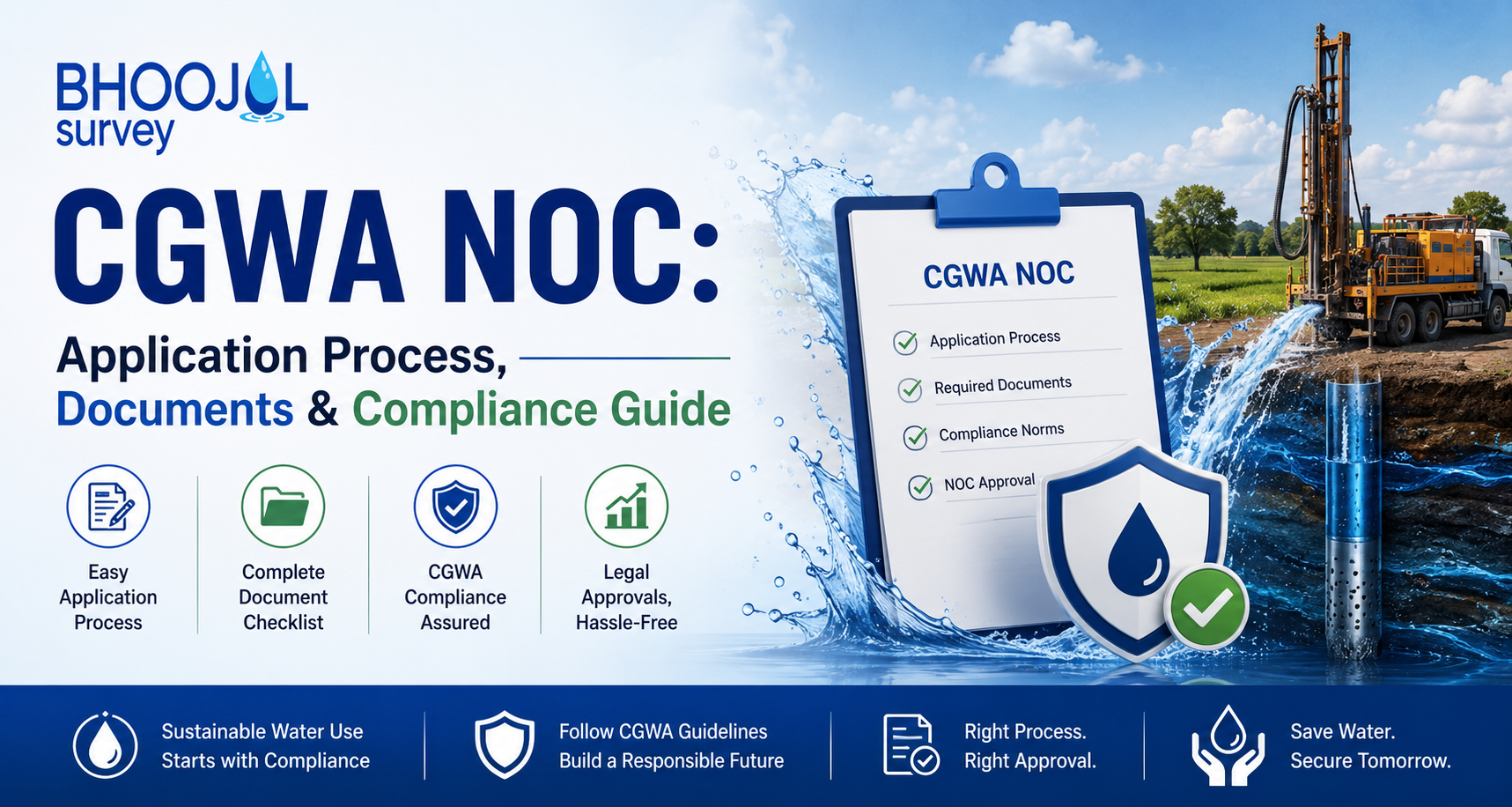
Groundwater extraction in India is not a free-access activity. For industries, real estate developers, infrastructure companies, and commercial establishments, withdrawing groundwater above the prescribed limit in notified areas requires a mandatory clearance from the Central Ground Water Authority -commonly known as CGWA NOC.
Without this No Objection Certificate, any borewell or tube well installed on the project site is legally non-compliant under the Environment (Protection) Act, 1986, and subject to sealing, penalty, and project stoppage.
The scale of India's groundwater crisis makes this regulation essential. The Central Ground Water Board has assessed that over 16% of India's groundwater assessment units are in the "over-exploited" category.
CGWA NOC is the government's primary tool to regulate extraction in these stressed zones and enforce sustainable use across industrial and commercial sectors.
Understanding the complete process -from eligibility to technical documentation to portal submission -is critical before initiating any groundwater extraction project. Learn more about Ground Water Survey that support CGWA NOC applications.
CGWA NOC Explained: Definition, Applicability and Who Needs It
CGWA NOC is the No Objection Certificate issued by the Central Ground Water Authority, a statutory body constituted under Section 3(3) of the Environment (Protection) Act, 1986, and functioning under the Ministry of Jal Shakti.
The NOC is a legal permit authorising groundwater extraction from a specific location, at a specified quantity, for a defined purpose.
As per CGWA's revised guidelines of 2020, the NOC requirement applies to industries and infrastructure projects extracting more than 10 cubic metres per day in notified areas.
Mining projects, regardless of extraction volume, require CGWA clearance without exception. Bulk water users -hospitals, hotels, IT parks, commercial complexes -fall under the same threshold. Agricultural extractions in certain notified areas are governed by State Ground Water Authorities running parallel to CGWA jurisdiction.
It is important to clarify that CGWA NOC and Borewell NOC are often used interchangeably but are not always identical. CGWA NOC is a central government clearance applicable to notified zones.
State-level borewell NOCs are issued by State Ground Water Authorities independently. In regulated areas, both may be required simultaneously, and applicants must coordinate compliance at both levels to avoid legal exposure.
Why CGWA NOC Cannot Be Deferred: Legal Risks and Project Impact
Many project developers treat CGWA NOC as a procedural afterthought -something to be arranged after construction begins. This approach carries serious legal risk.
The National Green Tribunal has issued multiple binding orders penalising unauthorised groundwater extraction, and CGWA has the authority to direct sealing of borewells installed without prior clearance.
Beyond enforcement, CGWA NOC is often a prerequisite for other approvals. Bank project financing, environmental clearance documentation, and building plan sanctions frequently require a valid CGWA NOC before proceeding.
Regularisation of existing unauthorised structures is possible but not guaranteed, and the process is more expensive and time-consuming than obtaining the NOC upfront.
There are five distinct types of CGWA NOC based on the nature of the application.
A Fresh NOC covers new groundwater extraction structures. A Renewal NOC is required when the existing clearance -typically valid for five years -reaches its expiry. An Enhancement NOC applies when an existing user seeks to increase extraction beyond the originally sanctioned quantity.
A Regularisation NOC covers structures installed without prior clearance. Finally, a No Extraction NOC serves as a certificate confirming zero groundwater use, required in specific project approval workflows.
How to Apply for CGWA NOC: Step-by-Step Process and Documents
The CGWA NOC application is handled entirely through the official CGWA portal at cgwa-noc.gov.in.
The process begins with applicant registration and project category selection, followed by submission of technical documentation. The portal requires the applicant to specify borewell coordinates in latitude/longitude format -errors here are among the most common reasons for rejection.
The critical component of any CGWA NOC application is the Hydrogeological Survey Report.
This is a technical document prepared by a qualified hydrogeologist, covering aquifer identification, depth to water-bearing zones, recharge potential, subsurface lithology, and sustainable yield estimation.
CGWA specifies technical criteria for these reports, and submissions that do not meet the standard are rejected without processing.
Along with the hydrogeological report, applicants must submit a Yield Test Report from the proposed borewell site, Earth Resistivity Test data collected through Vertical Electrical Sounding, land ownership or lease documents, a site location plan with GPS coordinates, a detailed project report, and an undertaking confirming the installation of a rainwater harvesting or groundwater recharge structure.
The recharge structure requirement is proportional to the extraction volume sought, and CGWA verifies this during site inspection if one is conducted.
Once all documents are uploaded and the application fee is paid, CGWA reviews the submission. A site inspection may be ordered depending on the area classification and project scale.
Standard processing takes 30 to 90 working days from the date of complete application. In over-exploited zones, scrutiny is significantly higher, and extraction permissions may be restricted irrespective of technical merit.
CGWA Portal Shift: From NOCAP to Bhuneer and What Changed in 2026
The CGWA NOC application system has migrated from the legacy NOCAP portal to the new Bhuneer Portal. This is not a minor update -the Bhuneer Portal runs on a completely restructured backend, and prior NOCAP registrations do not carry over automatically.
Existing NOC holders applying for renewal must complete a mandatory data migration first -entering the old NOCAP NOC number, verifying credentials, and uploading the original NOC certificate to link the legacy record with Bhuneer. Without this step, renewal filing cannot proceed.
The current 2026 CGWA framework has also tightened post-NOC compliance. Digital water flow meters with real-time telemetry must be installed on all abstraction structures within 30 days of NOC grant, with monthly extraction data uploaded through the portal -manual reporting is no longer accepted. Meters require annual calibration from a NABL-accredited agency.
Rainwater harvesting structures must meet updated Model Building Bye Laws 2025, and high-volume users must submit an annual Water Audit Report.
Renewal applications must be filed at least 90 days before NOC expiry to avoid a compliance gap. The fixed processing fee for a fresh application is currently ₹10,000.
Technology and Surveys Behind Every Successful CGWA NOC Application
The technical quality of a CGWA NOC application is directly proportional to the quality of field surveys conducted at the site. Geophysical investigation is the backbone of the hydrogeological report, and three methods are most commonly employed.
Electrical Resistivity Survey using the Vertical Electrical Sounding (VES) method with a Schlumberger array is the standard technique for aquifer mapping in both alluvial and hard rock terrains.
It measures subsurface resistivity to identify water-bearing strata, depth to the aquifer, and expected yield range. Ground Penetrating Radar (GPR) Survey is used for shallow formation imaging and fracture detection in crystalline rock areas. Electromagnetic (EM) Survey is effective in detecting conductive saturated zones at greater depths, particularly in areas where resistivity contrast between formations is low.
In large project sites requiring rapid aquifer characterisation, Drone Geophysical Survey integrates aerial data collection with magnetic and electromagnetic sensors, significantly reducing field time while improving spatial coverage.
The Yield Test of Borewell is a separate but equally critical field exercise. It involves pumping the borewell at a controlled rate, measuring drawdown and recovery, and calculating safe yield. The data feeds directly into the hydrogeological report and determines the extraction quantity CGWA will sanction.
CGWA NOC Cost in India and Reasons Applications Get Rejected
The total cost of obtaining a CGWA NOC in India varies significantly by project type, location, and the complexity of the hydrogeological setting. The CGWA portal fee ranges from ₹1,000 to ₹50,000 depending on the applicant category.
A Hydrogeological Survey and Report typically costs between ₹25,000 and ₹1,50,000. Yield testing and pump test charges range from ₹15,000 to ₹50,000, and Earth Resistivity Testing adds approximately ₹10,000 to ₹40,000.
Professional consultation, documentation, and portal management fees range from ₹20,000 to ₹80,000. Rainwater harvesting or recharge structures mandated as a condition of the NOC may add ₹50,000 to ₹3,00,000 depending on design requirements.
The most common reason for application rejection is an incomplete or technically deficient hydrogeological report. Incorrect GPS coordinates, missing recharge structure documentation, yield test data that contradicts reported field conditions, and failure to account for state-level NOC requirements are recurring issues that delay or invalidate applications.
How to Select the Right CGWA NOC Consultant for Your Project
The consultant engaged for CGWA NOC work must have qualified hydrogeologists with documented field experience, in-house geophysical survey capacity, and a demonstrable track record of successful CGWA approvals.
Consultants who subcontract survey work introduce data quality gaps that often surface during CGWA's technical review.
PAN India project experience matters because groundwater conditions -and therefore survey methodology -differ substantially between alluvial plains, Deccan basalt formations, hard rock terrain, and coastal aquifer systems.
Bhoojal Survey provides end-to-end CGWA NOC services, from initial site geophysical investigation and hydrogeological report preparation to portal submission, inspection coordination, and follow-up with CGWA authorities.
The firm operates with in-house Electrical Resistivity Meters, GPR systems, and EM instruments, ensuring survey data quality that supports technically sound NOC applications. All hydrogeological assessments are prepared to meet CGWA's technical guidelines and BIS standards applicable to groundwater investigations.
Why Choose Bhoojal Survey for CGWA NOC Services
Bhoojal Survey brings together experienced hydrogeologists, advanced geophysical equipment, and full regulatory knowledge to deliver CGWA NOC approvals efficiently.
The firm manages the complete process -geophysical survey, hydrogeological report, borewell yield test, earth resistivity testing, rainwater harvesting documentation, and CGWA portal submission -under one coordinated engagement.
With PAN India project experience across diverse geological formations and a consistent record of compliant submissions, Bhoojal Survey eliminates the technical gaps that cause rejections and delays.
Conclusion
CGWA NOC is a non-negotiable compliance requirement for any project involving significant groundwater extraction in India's notified zones.
The application demands technically rigorous documentation -hydrogeological reports, yield tests, resistivity data -that cannot be assembled without qualified field expertise. Delays in NOC compliance create cascading project risks that are far more costly than the clearance process itself.
For expert CGWA NOC services, geophysical surveys, hydrogeological assessments, and complete groundwater compliance support, contact Bhoojal Survey.
FAQs
Q1. Is a CGWA NOC mandatory for borewells across India?
No. A CGWA NOC is required only in CGWA-notified areas. In other locations, state groundwater authorities may have separate approval requirements.
Q2. How long is a CGWA NOC valid?
A CGWA NOC is generally valid for 5 years. It must be renewed before expiry, and compliance with all NOC conditions is required during its validity.
Q3. What happens if groundwater is extracted without a CGWA NOC?
Unauthorized groundwater extraction can lead to borewell sealing, financial penalties, and legal action under the Environment (Protection) Act, 1986.
Q4. Can I apply for a CGWA NOC without a consultant?
Yes. However, technical documents such as hydrogeological reports and yield test data must meet CGWA standards, making professional assistance beneficial.
Q5. What is the difference between a CGWA NOC and a Borewell NOC?
A CGWA NOC regulates groundwater extraction, while a Borewell NOC is issued by state or local authorities for borewell construction. Some projects may require both.