
Water Quality Testing Near Me for Borewell & Drinking Water
Is Your Groundwater Safe to Drink?
Groundwater contamination is one of the fastest-growing public health threats across India. Millions of households, farms, and businesses depend on borewells and open wells as their daily water source — yet the quality of that water is rarely tested through a certified, scientific process. This is why professional groundwater survey services are essential to identify underground water sources and evaluate their safety before use. When water looks clear and smells normal, most people assume it is safe. That assumption is wrong, and in many parts of India, it is quietly causing serious, long-term health damage.
When someone searches for water quality testing near me, they are usually responding to a real concern — a change in water taste, a health issue at home, a new borewell, or a project requirement. What they need is not a basic indicator kit but a professional, laboratory-grade analysis that delivers results they can actually trust and act upon.
Untreated groundwater carries hidden risks that no visual inspection can detect. Fluoride, arsenic, nitrate, heavy metals, and microbial pathogens are all colourless, odourless, and tasteless at contamination levels — but their health effects accumulate silently over months and years of daily consumption. Scientific water analysis is the only way to know what is truly in your water.
Professional groundwater investigation solves this problem by combining field survey, geophysical testing, and certified laboratory analysis into a single, integrated service — identifying contamination, mapping its source, and recommending the right treatment for the specific conditions at your site.
What is Water Quality Testing?
Drinking water quality testing is the systematic analysis of water samples to measure physical, chemical, and biological parameters that determine whether the water is safe for its intended use. It compares measured values against established national and international standards — in India, the primary reference is BIS IS 10500 for drinking water quality.
Key parameters evaluated in a standard water quality testing panel include:
- • pH level — Measures water acidity or alkalinity. Values outside the 6.5–8.5 safe range indicate chemical imbalance that can corrode pipes and affect health over time.
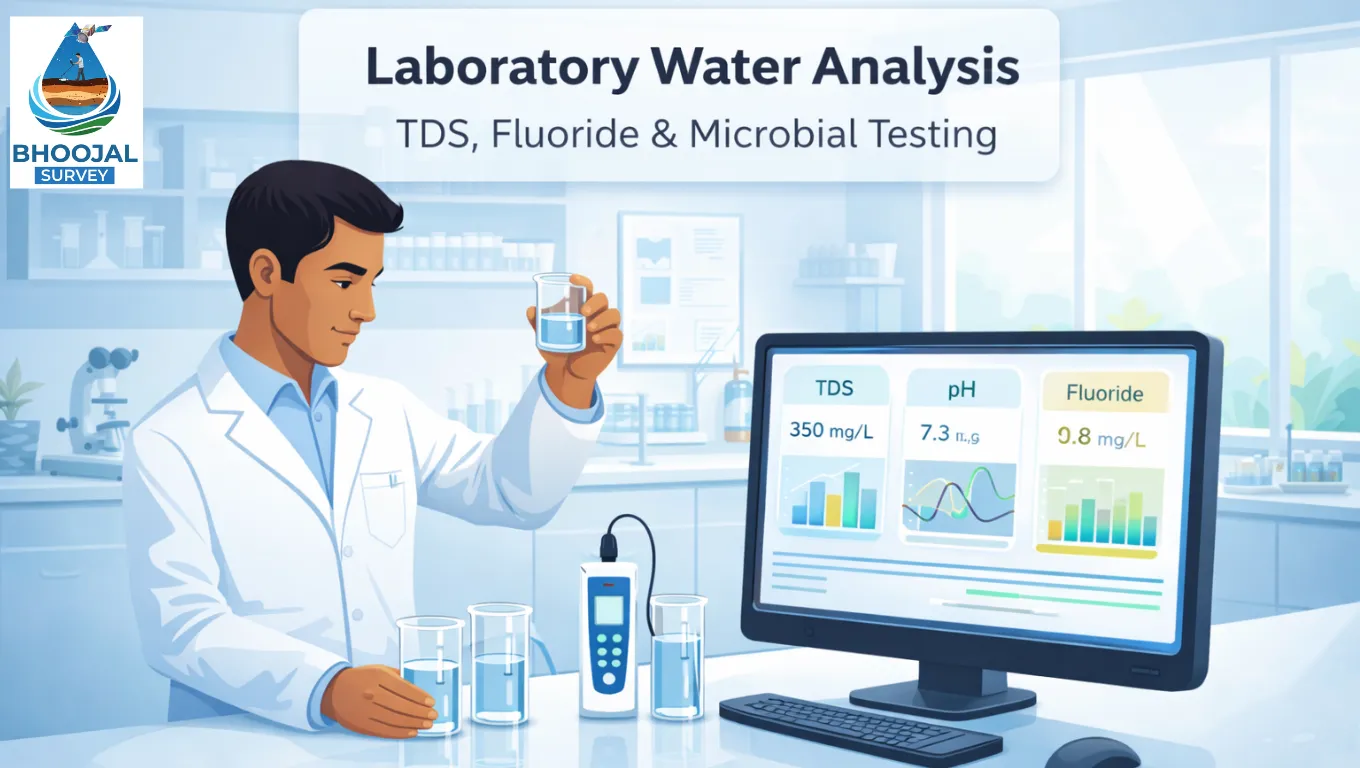
- • Total Dissolved Solids (TDS) — Measures total mineral and salt concentration. High TDS affects taste and can cause kidney stress with long-term consumption.
- • Hardness — Elevated calcium and magnesium cause scaling in pipes and appliances, and can contribute to digestive and skin problems.
- • Fluoride — Both excess and deficiency cause serious problems. High fluoride causes fluorosis — irreversible bone and dental damage — common in Gujarat, Rajasthan, and Andhra Pradesh.
- • Nitrate and Sulphate — Nitrate from agricultural fertilisers is a major contamination risk in farming areas. High nitrate is dangerous for infants and harmful to adults with long-term exposure.
- • Iron and Heavy Metals — Elevated iron causes rust-coloured water. Heavy metals — arsenic, lead, chromium — from industrial zones are acutely toxic even at very low concentrations.
- • Microbial contamination — Coliform bacteria and E. coli confirm faecal contamination, indicating immediate risk of typhoid, cholera, dysentery, and other waterborne diseases.
These parameters determine water suitability for drinking, agricultural irrigation, industrial processes, and construction use — making comprehensive groundwater testing a multi-purpose necessity for homeowners, farmers, and developers alike.
Why Water Quality Testing Cannot Be Skipped
The majority of water quality problems are completely invisible without laboratory analysis. Contaminated water can look perfectly clean while containing arsenic, nitrate, or pathogens at levels that cause serious, progressive harm. Testing is the only scientifically reliable way to confirm that your water is genuinely safe — not merely clear.
Key benefits of professional water contamination testing include:
- • Ensures safe drinking water — Confirms compliance with BIS IS 10500 standards for all critical parameters before the water is consumed by your household or workforce.
- • Early contamination detection — Identifies contamination at low concentrations before it reaches health-affecting levels, allowing action while the cost of intervention is still low.
- • Prevents waterborne diseases — Eliminates the risk of typhoid, dysentery, hepatitis A, and other diseases caused by microbial and chemical contamination of drinking sources.
- • Identifies harmful substances — Detects heavy metals, fluoride, arsenic, and nitrate that cause long-term organ damage invisible until serious health problems develop years later.
- • Selects the right treatment system — Accurate test data ensures the treatment technology installed actually matches the contamination type present — preventing both under-treatment and wasted investment.
- • Protects long-term groundwater resources — Regular testing tracks groundwater quality trends over time, enabling early management of aquifer deterioration before it becomes irreversible.
Borewell Water Testing: Test Before You Drink
Borewell water testing is essential for every property that uses groundwater as its primary water source. Borewell quality is not static — it changes with seasonal water table fluctuations, nearby land use changes, construction activity, and long-term aquifer degradation. A borewell that tested clean three years ago may be contaminated today without any visible sign of change.
Professional agencies offering groundwater survey services help developers, homeowners, and project teams locate the most productive and safest aquifer zones before drilling begins. Pre-installation surveys identify geological formations that are likely to yield clean water, and post-installation testing confirms the actual quality of water from the completed borewell before it enters daily use.
Installing an RO system or filtration unit without first testing your water is one of the most common and costly mistakes made at both household and project level. A system designed for iron removal provides no protection against microbial contamination or fluoride. Only a complete lab test report tells you exactly what treatment is actually needed for your specific water source.
Common Sources of Groundwater Contamination
Understanding where contamination enters the groundwater system is the first step toward controlling it. In India, multiple contamination pathways operate simultaneously across both rural and urban settings — and identifying the dominant source determines what treatment approach will actually be effective for a given location.
The most frequently identified sources of groundwater contamination include:
- • Industrial waste and effluent — Factory discharge, tanneries, chemical plants, and mining operations contaminate aquifers with heavy metals, solvents, and persistent toxic compounds that remain in groundwater for decades after the source is removed.
- • Agricultural runoff — Excessive fertiliser and pesticide use causes nitrate, phosphate, and organic chemical leaching into shallow aquifers, particularly in high-intensity farming districts across Punjab, Haryana, and Maharashtra.
- • Sewage and poor sanitation — Leaking septic tanks, open defecation zones, and unlined waste pits introduce faecal coliforms and pathogens directly into the shallow groundwater systems that supply most rural borewells.
- • Landfill leachate — Unscientific dumping sites generate leachate that percolates through soil into groundwater, carrying a complex mix of organic compounds and heavy metals from decomposing waste.
- • Natural mineral deposits — Geological formations across large parts of India naturally release arsenic, fluoride, iron, and uranium into groundwater — contamination that is entirely unrelated to human activity but equally dangerous to health.
Expert Groundwater Investigation Services
Bhoojal Survey specialises in comprehensive scientific groundwater investigation and water quality analysis for residential users, farmers, infrastructure developers, and solar energy project teams across India. Their integrated approach combines advanced geophysical field investigation with certified laboratory water analysis — delivering complete, site-specific results rather than generic estimates.
Core services provided by Bhoojal Survey's expert groundwater team include:
- • Groundwater detection surveys — Scientific identification of productive aquifer zones using geophysical methods before borewell drilling, significantly improving success rates and reducing drilling cost.
- • Hydrogeological surveys — Detailed subsurface investigation covering aquifer depth, type, seasonal water table fluctuation, and soil permeability across the full project or property area.
- • Soil resistivity testing — Electrical resistivity measurement of soil and rock layers to map subsurface geology, identify water-bearing zones, and detect contamination plume boundaries.
- • Borewell location surveys — Site-specific optimum borewell location identification using terrain analysis and geophysical investigation to minimise dry-hole risk.
- • Water quality testing and analysis — Full physical, chemical, and biological parameter analysis of water samples with lab-certified reports and BIS IS 10500 comparisons.
- • Hydrological studies for infrastructure — Water availability and quality assessment for solar parks, industrial zones, and construction projects requiring certified water data for design and regulatory submissions.
Bhoojal Survey's field investigations are conducted using industry-grade instruments including the SSR-MPATS multi-electrode resistivity system for subsurface layer mapping, the PQWT groundwater detector for electromagnetic identification of water-bearing fractures in hard rock terrain, and the GER Detect multi-frequency geophysical system for locating subsurface water pockets and buried drainage anomalies.
Advantages of Professional Groundwater Services
Choosing professional water testing laboratory services over basic kit testing or unverified field reports makes a significant difference in the reliability and usefulness of the results you receive. Key advantages of working with qualified groundwater investigation specialists include:
- • Experienced professionals — Investigations conducted by qualified hydrogeologists with field experience across India's diverse geological and hydrological environments, from hard rock Deccan Plateau to alluvial Indo-Gangetic plains.
- • Advanced scientific instruments — SSR-MPATS, PQWT, and GER Detect systems deliver subsurface investigation accuracy that no basic manual method can match, reducing guesswork and failed borewells.
- • Accurate site investigation — Every survey is conducted on-site using actual ground data — not generalised regional maps or desk-based estimates that fail to capture local groundwater variability.
- • Reliable, certified reporting — Lab-certified water quality reports with parameter-wise BIS comparisons and clear professional interpretation — not raw numbers without context.
- • Diverse project support — From single household borewell testing to groundwater assessment for 500-acre solar parks and industrial facilities, the investigation scope scales to match your project size and complexity.
Hydrological Studies and Water Management
Water quality cannot be assessed in isolation from the broader hydrological system it is part of. Surface water flow, catchment drainage patterns, and seasonal groundwater recharge all influence the chemical and biological quality of groundwater drawn from any borewell or well. Understanding these connections is what separates a scientific investigation from a simple point-sample test.
Hydrological analysis identifies where water comes from, how it moves through the landscape, and which surface or sub-surface pathways introduce contamination into the aquifer. Agencies offering integrated flood modeling services combine terrain analysis, rainfall data, and drainage mapping to identify how storm events alter groundwater flow directions and introduce surface contaminants into shallow aquifers during and after major rainfall — critical information for both water quality management and infrastructure protection.
How Flooding Affects Drinking Water Quality
Flood events are one of the most significant and underestimated threats to groundwater quality across India. When floodwater inundates low-lying areas, it carries agricultural chemicals, sewage, industrial pollutants, and soil-borne pathogens directly into shallow aquifer systems. Borewells that were previously clean can become heavily contaminated within hours of a flood event reaching their surrounding area.
Post-flood water contamination testing is essential before resuming use of any groundwater source exposed to inundation. Comprehensive flood risk assessment studies provide site-specific flood inundation mapping that identifies which borewells, wells, and groundwater extraction points are most vulnerable to contamination during extreme rainfall and flood events — enabling proactive protection measures that preserve water quality before an event occurs rather than requiring expensive remediation after.
Regional Groundwater Conditions Vary Widely
Groundwater quality and aquifer conditions change significantly across short distances in India. The geological formations, depth to water table, dominant contamination sources, and seasonal fluctuation patterns in one district can be completely different from the next. This is why generic water quality assumptions — or testing data from a neighbouring property — are not a reliable substitute for a site-specific investigation.
In Central India, for example, detailed pre-installation assessment through groundwater survey in Indore has helped residential colonies, solar developers, and infrastructure contractors identify clean aquifer zones and avoid contaminated geological formations before drilling — saving significant time, money, and health risk compared to discovering problems after the borewell is already in use. This regional approach to groundwater investigation is what makes site-specific surveys consistently more valuable than generalised water quality maps.
When Should You Get Your Water Tested?
Many people only seek water quality testing near me after a visible problem appears. By that point, contamination exposure has often been ongoing for months or years. The right time to test is before a problem becomes apparent:
- • Before borewell installation — Every new borewell must be tested immediately after drilling and before first use to establish a clean baseline and confirm the aquifer tapped is safe.
- • When water quality changes — Any change in water taste, colour, odour, or clarity is a signal of a change in aquifer conditions or a new contamination source — requiring immediate professional investigation.
- • When moving to a new property — Never assume the groundwater at a new location is safe based on appearance. Test it before use, regardless of what the previous occupants reported.
- • After any flooding event — Post-flood testing is essential before resuming groundwater use. Contamination introduced during flooding may not clear naturally for weeks or months.
- • During infrastructure development — Solar parks, industrial facilities, and construction projects using groundwater for operations require certified water quality data for design, safety, and regulatory compliance.
- • As an annual routine check — Groundwater quality shifts gradually over time. Annual testing detects developing trends early, enabling preventive action before contamination reaches harmful levels.
Get Certified Water Testing — Near You, Right Now
If you are searching for water quality testing near me, do not settle for a kit reading or an uncertified field report. Contact Bhoojal Survey for a complete, laboratory-grade water analysis covering all critical physical, chemical, and biological parameters — with certified results, clear interpretation, and practical treatment recommendations you can act on immediately.
Call us now: +91-96918 58058 — or fill in the contact form to request a quote for professional water quality testing at your specific location across India.
Conclusion: Safe Water Needs Scientific Testing
Safe drinking water is not something that can be assumed — it must be verified through scientific analysis. Whether you are a homeowner relying on a borewell, a farmer depending on groundwater for irrigation, or a developer planning a solar park or infrastructure project, professional drinking water quality testing is the only way to confirm that your water is genuinely safe and suitable for its intended use.
The benefits of scientific groundwater investigation extend well beyond a single test result. A comprehensive investigation identifies contamination sources, maps aquifer conditions, guides treatment system design, and provides the baseline data needed for long-term water resource management. These are not optional inputs — they are the foundation of responsible water use at any scale.
The next time you search for water quality testing near me, choose an expert agency that combines field investigation, advanced instruments, and certified laboratory analysis. That is the standard your drinking water safety deserves — and exactly what Bhoojal Survey delivers across India.
FAQs: Water Quality Testing Near Me
What does a water quality test check for?
A professional water quality testing panel checks for pH, Total Dissolved Solids (TDS), hardness, turbidity, fluoride, nitrate, sulphate, iron, arsenic, chloride, and microbial parameters including total coliform and E. coli. Extended panels include heavy metals such as lead, chromium, and cadmium, plus pesticide residues for sites near agricultural land. The appropriate panel depends on your location, surrounding land use, and known or suspected contamination sources in the area.
How often should borewell water be tested?
Borewell water testing should be performed at least once a year as a routine safety check, and additionally after any change in water appearance, taste, or odour, following any flood event, or when new industrial or agricultural activity begins near the borewell. Every new borewell must be tested immediately after drilling — before its water is consumed or used for irrigation — to confirm the quality of the aquifer tapped.
Why is groundwater testing important for projects?
Groundwater testing is essential for solar parks, industrial facilities, and infrastructure projects that use borewell water for construction, equipment cooling, dust suppression, or workforce water supply. Using untested water in construction operations risks equipment damage, workforce health incidents, and regulatory non-compliance. A certified water quality report is also increasingly required in Environmental Impact Assessment (EIA) submissions and state-level infrastructure approvals across India.
What instruments does Bhoojal Survey use?
Bhoojal Survey uses three advanced field instruments for groundwater investigation: the SSR-MPATS multi-electrode resistivity system for detailed subsurface layer mapping across large sites, the PQWT groundwater detector for electromagnetic identification of water-bearing fractures in hard rock terrain, and the GER Detect multi-frequency geophysical system for locating subsurface water pockets and buried drainage anomalies. These instruments produce investigation results that basic manual drilling methods cannot achieve.
How do I find water quality testing near me?
When searching for water quality testing near me, look for an agency that employs qualified hydrogeologists, uses calibrated and certified laboratory equipment, provides reports that compare results to BIS IS 10500 standards, and offers clear treatment recommendations — not just raw numbers. Bhoojal Survey provides all of these services across India, covering both simple single-borewell tests and complex multi-source assessments for large infrastructure and solar energy projects.