
CGWA Permission Now
Groundwater approval delays are one of the most common — and most preventable — causes of project schedule overruns in industrial and infrastructure development across India. When an industry fails to secure CGWA permission for groundwater extraction before commencing operations, the consequences range from regulatory notices and financial penalties to forced borewell shutdowns and production halts that can take months to resolve.
The Central Ground Water Authority (CGWA) is India's apex regulatory body for groundwater management, operating under the Ministry of Jal Shakti. Any industrial, commercial, or infrastructure project that requires groundwater extraction above prescribed limits in notified or non-notified zones must obtain CGWA permission before beginning extraction. This is not a procedural formality — it is a legal requirement under the Environment (Protection) Act, 1986.
Bhoojal Survey provides professional CGWA permission for groundwater services across India — managing the complete approval process from hydrogeological field investigation and technical report preparation through to regulatory application submission and follow-up consultancy.
What is CGWA Permission for Groundwater
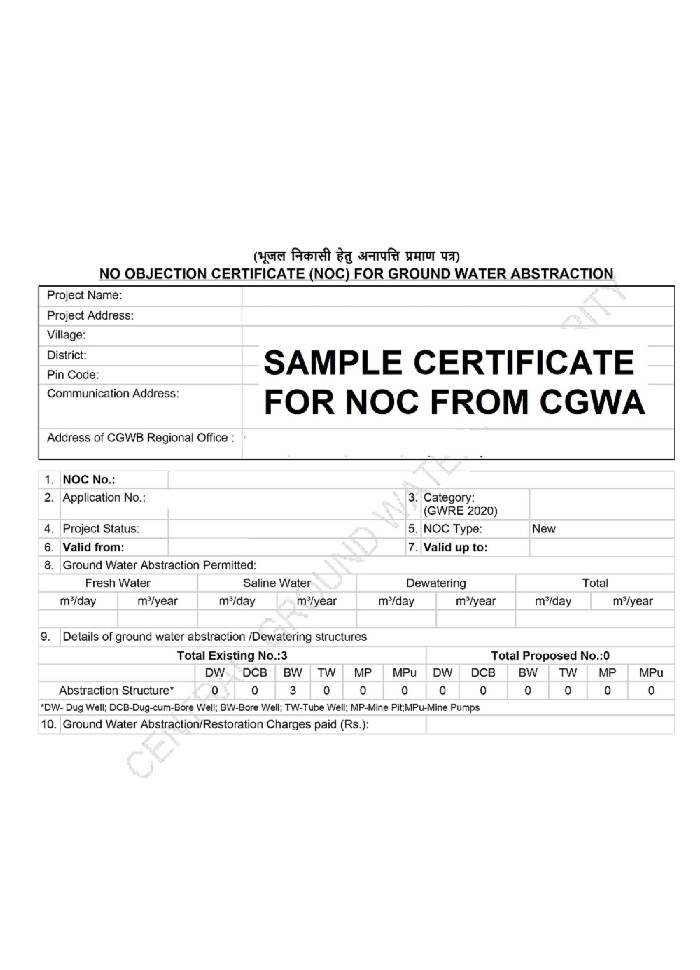
CGWA permission for groundwater is the formal regulatory authorisation issued by the Central Ground Water Authority that grants an entity the legal right to extract groundwater from subsurface aquifers for industrial, commercial, infrastructure, or other uses above the prescribed free-use threshold. The permission specifies the permitted extraction volume, borewell details, monitoring requirements, and conditions that the permission holder must comply with during the validity period.
The CGWA operates a digital permission system through which applicants submit their groundwater extraction requests online, supported by technical documentation including hydrogeological investigation reports, site plans, water requirement justifications, and compliance declarations. The authority evaluates each application against aquifer sustainability criteria, regional groundwater status, and environmental guidelines before granting permission.
CGWA groundwater permission is required for the following categories of use:
- Industrial units extracting groundwater for manufacturing, processing, or cooling
- Mining projects requiring groundwater dewatering or process water supply
- Infrastructure and construction projects with significant groundwater requirements
- Commercial complexes, hotels, hospitals, and large residential developments
- Bottling plants, beverage industries, and food processing facilities
- Government projects and public utilities with bulk groundwater extraction needs
- Any user extracting groundwater by borewell in CGWA-notified areas
Why CGWA Permission for Groundwater is Important
India's groundwater resources are under severe stress. The country accounts for nearly 25 per cent of global groundwater extraction — more than the United States and China combined. The CGWA permission system exists to manage this extraction sustainably, protect aquifer health, and ensure that industrial and commercial groundwater use does not permanently deplete resources that communities and agriculture depend on.
- Legal Groundwater Extraction Compliance: Operating a borewell for commercial or industrial extraction without CGWA permission is a violation of the Environment (Protection) Act, 1986. Industries found in violation face financial penalties, borewell sealing orders, and adverse records affecting future environmental clearances.
- Sustainable Groundwater Management: The CGWA permission process evaluates whether the requested extraction is sustainable relative to aquifer recharge rates and existing extraction levels in the area — protecting the long-term viability of your own water source as well as surrounding groundwater users.
- Environmental Protection Requirements: Many environmental clearances, pollution control permissions, and ISO environmental certifications require evidence of valid CGWA groundwater permission as a prerequisite document — making timely approval essential for overall project environmental compliance.
- Avoiding Penalties and Legal Issues: Regulatory enforcement actions for unpermitted groundwater extraction include not just penalties on the current operation but adverse compliance history that complicates future approval processes, project expansions, and investment due diligence assessments.
- Supporting Responsible Groundwater Usage: The CGWA permission process includes conditions for rainwater harvesting, water metering, piezometer installation, and annual extraction reporting — practices that promote responsible groundwater management and protect the long-term sustainability of the project's water supply.
Methods Used for Groundwater Investigation and CGWA Approval
A technically robust hydrogeological investigation is the foundation of every successful CGWA permission application. Bhoojal Survey uses advanced field investigation methods and scientific analysis techniques to prepare groundwater assessment reports that meet CGWA documentation standards and support timely approval.
- Hydrogeological Investigation:
Comprehensive field assessment of site geology, aquifer type, groundwater occurrence conditions, water table depth, and seasonal groundwater level variation. The investigation includes detailed mapping of aquifer characteristics relevant to the proposed extraction volume and borewell depth. Bhoojal Survey conducts hydrogeological survey using SSRMPATS Instrument, GER DETECT, and PQWT at site for open well / borewell location — delivering advanced groundwater and geophysical survey solutions with scientific groundwater investigation and analysis.
- Geophysical Resistivity Survey:
Electrical resistivity measurements are used to characterise subsurface formations, identify aquifer zones, and assess groundwater potential at the proposed extraction site. Resistivity data provides objective scientific evidence of aquifer conditions that supports the permission application's groundwater availability claims.
- Groundwater Availability Analysis:
Analysis of regional groundwater data from CGWB and state groundwater authority records, combined with site-specific investigation data, to assess whether the proposed extraction volume is sustainable relative to local recharge rates and existing extraction levels.
- Aquifer Mapping Techniques:
Integration of geophysical data, borewell logs, and hydrogeological field observations to develop a subsurface aquifer model for the site — defining aquifer depth, thickness, hydraulic characteristics, and groundwater quality parameters relevant to the proposed use.
- Documentation and Regulatory Assessment:
Preparation of the complete CGWA application documentation package — hydrogeological report, site maps, water requirement justification, compliance declarations, and supporting technical data — formatted for CGWA online portal submission and review.
Applications of CGWA Groundwater Permission Services
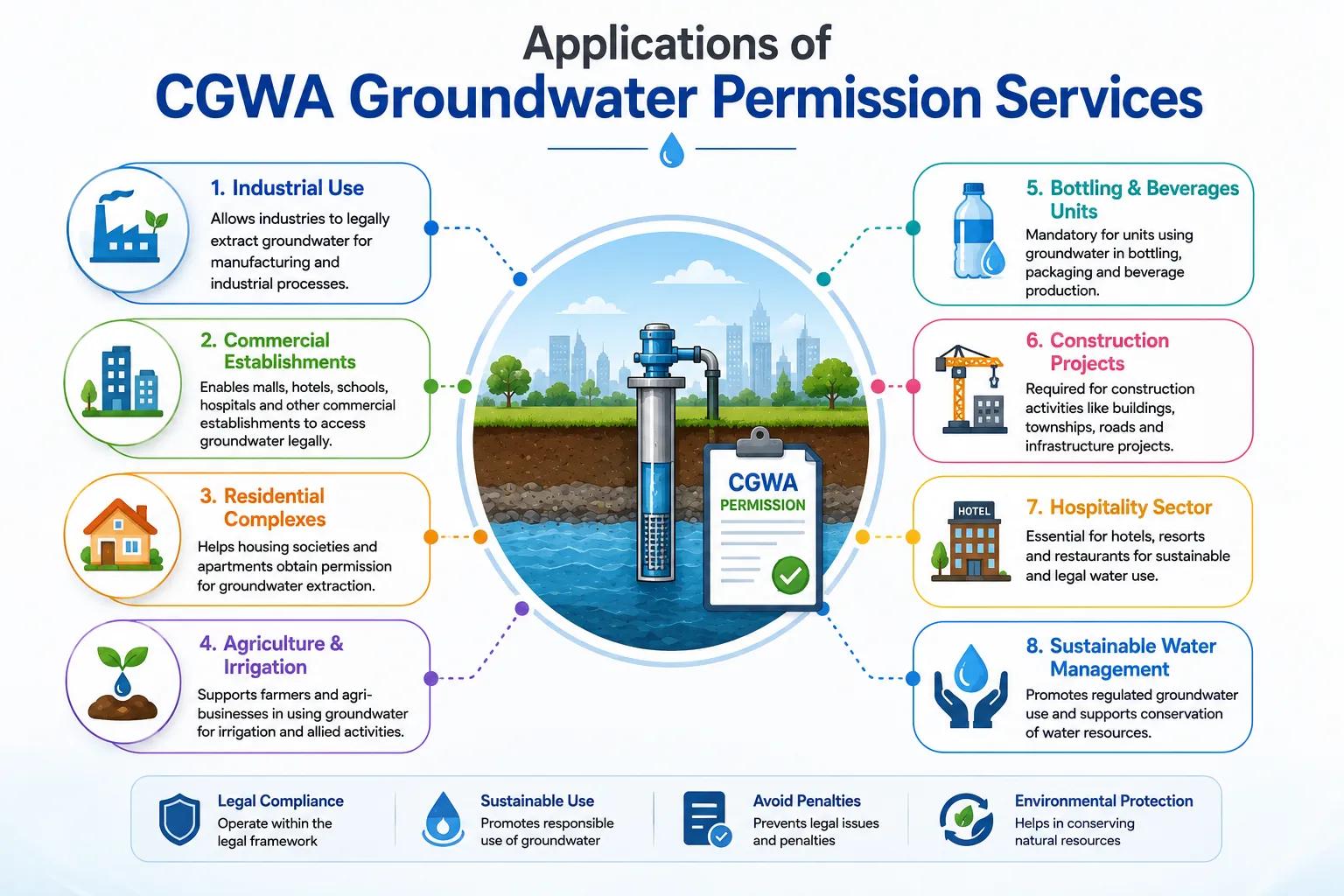
Bhoojal Survey has provided professional CGWA permission for groundwater consultancy across a broad range of industry sectors and project types throughout India. Our hydrogeological expertise and regulatory knowledge supports the following application categories:
• Manufacturing & Industrial Facilities
• Commercial Complexes & Real Estate
• Mining & Quarrying Operations
• Government Infrastructure Projects
• Infrastructure & Construction Projects
• Hospitals, Hotels & Institutional Projects
• Bottling Plants & Beverage Industries
• Residential Townships & SEZs
For each project type, Bhoojal Survey prepares the complete hydrogeological investigation and CGWA documentation package — ensuring your application is technically sound, correctly formatted, and supported by the scientific data CGWA reviewers need to process approvals efficiently.
Why Choose Bhoojal Survey for CGWA Permission Services
Navigating the CGWA permission process requires both hydrogeological expertise and regulatory knowledge. Bhoojal Survey provides both — combining scientific groundwater investigation capabilities with deep practical experience of CGWA documentation requirements, application procedures, and approval processes.
- Experienced Groundwater Compliance Consultants: Our team has managed CGWA
- Advanced Hydrogeological Investigation Capabilities: We deploy state-of-the-art geophysical instruments for site investigation, producing technically rigorous hydrogeological reports that meet CGWA documentation standards and withstand regulatory scrutiny.
- Accurate Documentation and Reporting: Every CGWA application we prepare is complete, accurate, and formatted to avoid the common documentation deficiencies that cause application rejections and processing delays.
- Fast CGWA Consultancy Support: Our efficient project workflow moves from site investigation to application submission within your project timeline — helping you secure CGWA permission before construction completion and operational start dates.
- Pan-India Groundwater Consultancy Services: Bhoojal Survey provides CGWA permission services across all Indian states and groundwater zones — covering the full range of aquifer types, geological environments, and regulatory jurisdictions.
- Customised Groundwater Approval Solutions: Whether you need permission for a single industrial borewell or a multi-well groundwater extraction system for a large industrial park, we design the investigation and documentation programme precisely matched to your project requirements.
Conclusion
Securing CGWA permission for groundwater is a non-negotiable legal step for every industry and project dependent on groundwater extraction in India. The permission process demands accurate hydrogeological investigation, precise technical documentation, and a clear understanding of CGWA regulatory requirements — all of which Bhoojal Survey delivers as part of its professional groundwater compliance consultancy service.
Delays in CGWA permission are almost always caused by incomplete documentation, inadequate hydrogeological reports, or application errors — all preventable with the right consultancy support. With Bhoojal Survey managing your CGWA permission application, your project benefits from scientific rigour, regulatory knowledge, and documentation accuracy that minimises approval risk and protects your operational timeline.
Contact Bhoojal Survey for professional CGWA permission for groundwater and hydrogeological compliance consultancy services across India.
Frequently Asked Questions (FAQ)
1. What is CGWA permission for groundwater and who issues it?
CGWA permission for groundwater is a formal regulatory authorisation issued by the Central Ground Water Authority — the apex body under the Ministry of Jal Shakti, Government of India — that grants legal permission for groundwater extraction above prescribed free-use thresholds. It applies to industrial, commercial, infrastructure, and other regulated groundwater users in both notified and non-notified groundwater areas across India. The permission specifies extraction volumes, borewell details, monitoring conditions, and compliance requirements for the validity period.
2. Who requires CGWA permission for groundwater extraction?
CGWA permission is required for industries, commercial establishments, infrastructure projects, mining operations, bottling plants, real estate developers, and any other entity extracting groundwater by borewell or open well above the prescribed free-use limit in CGWA-regulated areas. This includes both new extraction projects and existing users whose CGWA permission has expired and requires renewal. Domestic users below prescribed extraction thresholds in non-notified areas are generally exempt, but all commercial and industrial users should verify their requirement with a qualified CGWA compliance consultant.
3. Is hydrogeological investigation mandatory for CGWA permission?
Yes. A hydrogeological investigation report is a core requirement for the CGWA permission application. The report must include site-specific aquifer assessment, groundwater availability analysis, proposed extraction justification, and technical data supporting the sustainability of the requested extraction volume. Bhoojal Survey conducts comprehensive hydrogeological field surveys using advanced geophysical instruments — SSRMPATS, GER DETECT, and PQWT — to produce investigation reports that meet CGWA documentation standards.
4. What documents are required for CGWA groundwater permission?
Key documents include the hydrogeological investigation report, site location map with coordinates, project description and groundwater requirement justification, land ownership or lease documents, borewell technical details, proposed groundwater extraction volume and purpose, rainwater harvesting plan, piezometer installation proposal, and compliance declaration. Bhoojal Survey prepares, verifies, and submits the complete documentation package for CGWA online portal submission — eliminating the document deficiencies that commonly delay approvals.
5. How long does the CGWA permission process take in India?
CGWA permission processing typically takes 60 to 120 days for straightforward industrial applications with complete documentation. Complex projects, large extraction volumes, or sites in over-exploited groundwater zones may take longer. The most significant delays occur due to incomplete documentation at submission — which triggers CGWA queries and restarts the review clock. Engaging Bhoojal Survey as your CGWA permission consultant significantly reduces processing time by ensuring the application is complete, technically accurate, and correctly formatted for first-submission approval.