
Central Ground Water Authority
Groundwater extraction in India is not unregulated — and for good reason. With aquifer levels declining across major industrial and agricultural belts, the government has established strict controls on who can extract groundwater, how much, and under what conditions. At the centre of this regulatory framework sits the Central Ground Water Authority — India's apex body for groundwater governance.
For any industry, infrastructure project, or commercial development that depends on groundwater, understanding and complying with Central Ground Water Authority regulations is not just a legal obligation — it is a business-critical requirement. Bhoojal Survey provides professional CGWA consultancy services and hydrogeological investigation support to help clients navigate this process efficiently across India.
What Is the Central Ground Water Authority?
The Central Ground Water Authority (CGWA) is a statutory authority established by the Government of India under the Environment (Protection) Act, 1986. It operates under the Ministry of Jal Shakti and is responsible for regulating and controlling the development and management of groundwater resources across the country.
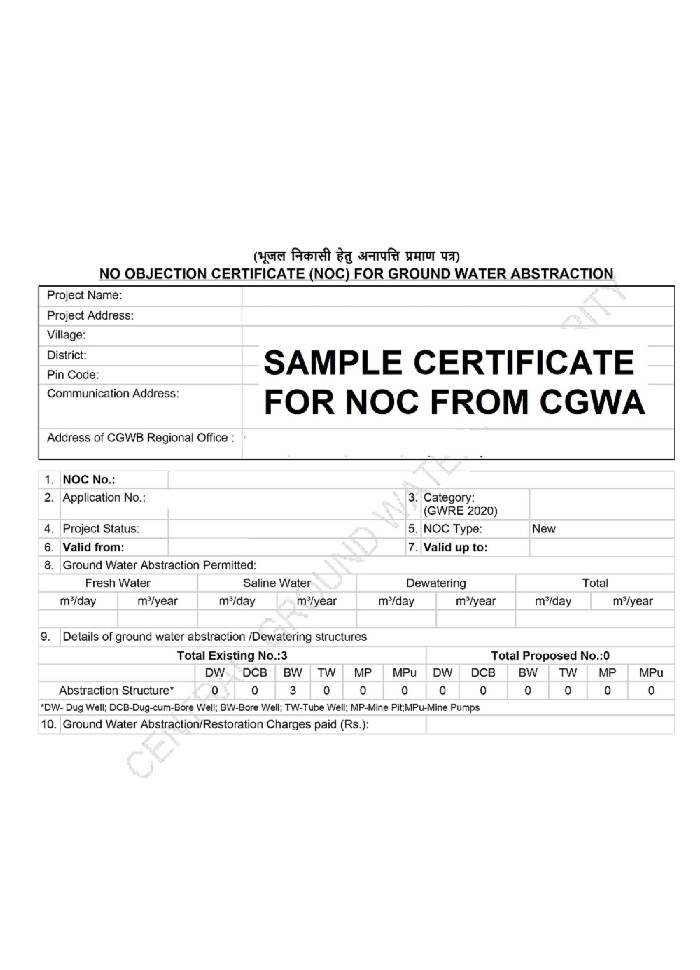
The CGWA sets groundwater extraction rules, designates over-exploited and critical groundwater assessment units, and issues permissions — commonly known as No Objection Certificates (NOCs) — for groundwater abstraction by industries, infrastructure developers, and large commercial users.
In simple terms, if your project needs to extract groundwater beyond prescribed limits, the Central Ground Water Authority is the regulatory body whose approval you must obtain before operations can legally begin.
Why Central Ground Water Authority Approval Is Important
Obtaining Central Ground Water Authority approval is not a bureaucratic formality — it carries real legal, environmental, and operational consequences:
- Legal Groundwater Extraction Compliance — Extracting groundwater without CGWA approval in notified areas is a violation of environmental law, carrying penalties, project shutdowns, and legal liability.
- Sustainable Groundwater Management — CGWA regulations ensure that groundwater abstraction remains within sustainable limits, protecting long-term water availability for all users.
- Environmental Protection — Uncontrolled extraction leads to land subsidence, aquifer contamination, and ecosystem damage — all risks that CGWA compliance helps prevent.
- Industrial Groundwater Regulation — Manufacturing plants, mining operations, and large commercial complexes face mandatory CGWA scrutiny before groundwater systems can be commissioned.
- Avoiding Penalties and Project Delays — Non-compliance can trigger environmental notices, construction halts, and financial penalties that far exceed the cost of proper compliance from the outset.
For any project in India that relies on groundwater, early CGWA engagement is essential — not optional.
Services Related to Central Ground Water Authority Compliance
Navigating Central Ground Water Authority requirements involves several interconnected technical and documentation services:
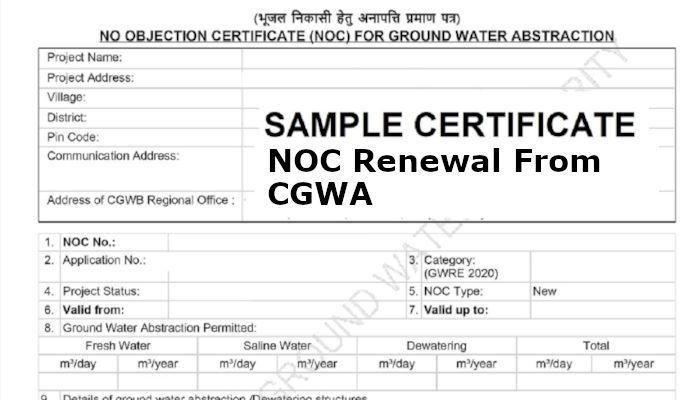
Groundwater NOC Approval — Preparation and submission of complete CGWA NOC applications including hydrogeological data, site assessment reports, and extraction justification documentation.
Hydrogeological Investigation — Scientific field investigation of subsurface aquifer conditions to establish groundwater availability, depth, and sustainable yield — mandatory for CGWA submission.
Groundwater Monitoring Systems — Installation and reporting of groundwater level monitoring infrastructure as required under CGWA conditions for approved extraction sites.
Borewell Permission Consultancy — End-to-end support for borewell permission processes including site selection, yield testing, and regulatory documentation.
Groundwater Recharge Planning — Designing artificial recharge structures and rainwater harvesting systems required as mitigation conditions under CGWA groundwater extraction permissions.
At Bhoojal Survey, our field teams support all these services by conducting hydrogeological surveys using SSRMPATS Instrument, GER DETECT, and PQWT at site for open well and borewell location — providing advanced groundwater and geophysical survey solutions built on scientific groundwater investigation and analysis.
Industries That Require CGWA Compliance in India
The Central Ground Water Authority mandates compliance across a broad range of sectors wherever groundwater extraction exceeds prescribed thresholds:
- Manufacturing Industries — Textile mills, food processing plants, chemical factories, and pharmaceutical units requiring consistent process water supply
- Mining Projects — Open-cast and underground mines where groundwater dewatering is essential for safe operations
- Infrastructure Developments — Highways, metro rail projects, tunnels, and large-scale civil works requiring construction dewatering
- Commercial Complexes — Malls, hotels, hospitals, and office parks with significant daily water demands
- Residential Townships — Large housing developments and integrated townships dependent on borewell water supply
- Industrial Parks and SEZs — Special economic zones and industrial estates with multiple groundwater users within a defined boundary
- Construction Projects — High-rise buildings and large foundations requiring groundwater management during construction
Why Choose Bhoojal Survey for CGWA Consultancy?
Bhoojal Survey is a trusted name in professional CGWA consultancy services and groundwater approval services in India, with a strong track record across industrial, infrastructure, and government projects:
- Experienced Groundwater Consultants with deep expertise in CGWA regulations, documentation, and compliance workflows
- Advanced Hydrogeological Investigation Technologies including SSRMPATS, GER DETECT, and PQWT for accurate aquifer characterisation
- Accurate Compliance Documentation meeting all CGWA technical report and data submission requirements
- Pan-India Groundwater Services covering notified, over-exploited, and semi-critical groundwater assessment units
- Professional Reporting and Consultancy aligned with Ministry of Jal Shakti and CGWB technical standards
- Customized Groundwater Management Solutions designed around your project's specific extraction needs, timeline, and compliance obligations
Conclusion
The Central Ground Water Authority plays a vital role in protecting India's most critical hidden resource — and its regulations are only becoming stricter as groundwater stress increases across the country. For industries, developers, and infrastructure planners, proactive CGWA compliance is not just about avoiding penalties — it is about building projects on a foundation of legal certainty and environmental responsibility.
Bhoojal Survey combines scientific hydrogeological investigation expertise with proven regulatory compliance experience to deliver groundwater compliance consultancy and CGWA NOC support services that keep your project on track.
📞 Contact Bhoojal Survey today for expert Central Ground Water Authority consultancy, hydrogeological assessment, and professional groundwater approval services across India.
Frequently Asked Questions (FAQs)
Q1. What is the Central Ground Water Authority? The Central Ground Water Authority is a statutory regulatory body under India's Ministry of Jal Shakti, established to regulate groundwater extraction, issue NOC approvals, and ensure sustainable groundwater management across the country.
Q2. Who requires CGWA approval in India? Industries, mining operations, infrastructure developers, commercial complexes, and residential townships that extract groundwater beyond prescribed limits — especially in notified, over-exploited, or critical groundwater zones — require mandatory CGWA groundwater extraction permission.
Q3. How does the CGWA regulate groundwater extraction? The CGWA designates groundwater assessment units based on exploitation levels, sets extraction limits, mandates hydrogeological investigation reports, requires groundwater monitoring systems, and issues time-bound NOCs with conditions including recharge obligations.
Q4. Is a hydrogeological investigation required for CGWA approval? Yes. A scientific hydrogeological investigation report — including aquifer data, groundwater depth, yield assessment, and sustainability analysis — is a mandatory component of every CGWA NOC application.
Q5. What documents are needed for CGWA groundwater permission? Key documents include a hydrogeological investigation report, site location maps, groundwater extraction details, borewell specifications, proposed recharge structure plans, and project-specific groundwater usage justification — all prepared in accordance with CGWA guidelines.