
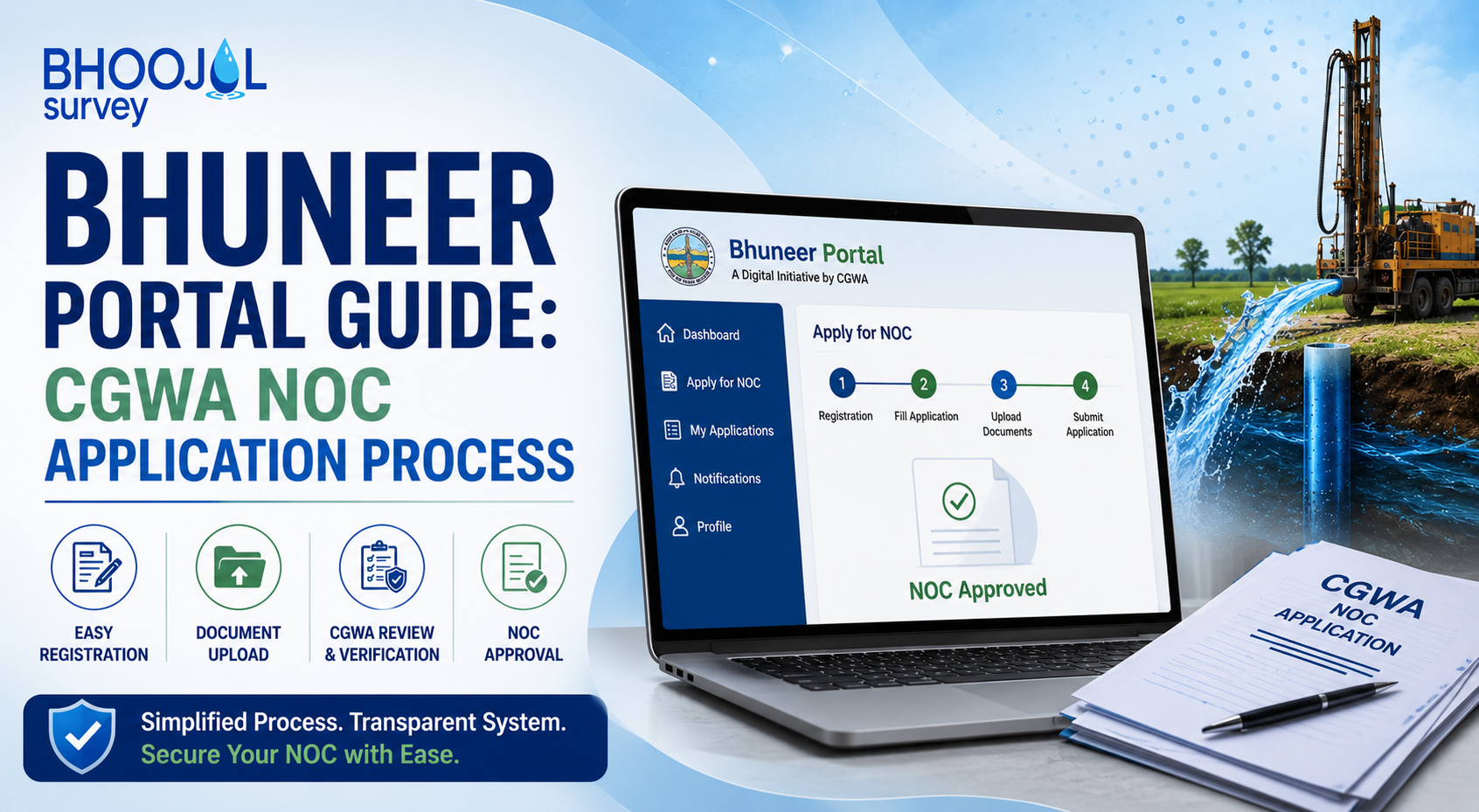
The Central Ground Water Authority has replaced its decade-old NOCAP portal with a new digital platform called the Bhuneer Portal.
Officially launched during the closing ceremony of India Water Week 2024 by the Ministry of Jal Shakti, the Bhuneer Portal is now the only authorised system for filing CGWA NOC applications for groundwater extraction in India.
Developed jointly by CGWA and the National Informatics Centre (NIC), the portal is designed to make groundwater regulation faster, paperless, and more transparent.
If your industry, infrastructure project, or mining operation requires a CGWA NOC -or if you hold an existing NOC issued under the old NOCAP system -everything now runs through the Bhuneer Portal.
This guide covers what the portal is, how it differs from NOCAP, who needs to use it, and how the complete application process works in 2026.
What Is the Bhuneer Portal and Why CGWA Replaced NOCAP With It
The Bhuneer Portal -accessible at cgwa-bhuneer.mowr.gov.in -is a centralised digital platform for regulating groundwater extraction across India.
The name "Bhu-Neer" is derived from Sanskrit, meaning "earth water," and reflects the portal's purpose: managing the nation's groundwater resources through a single, regulated online system.
The old NOCAP portal had been in use for years but was increasingly inadequate -slow processing, limited tracking capability, manual data entry, and no integration with compliance monitoring systems. The Bhuneer Portal addresses all of these limitations.
It provides real-time application tracking, integrated online fee payment through Bharatkosh, a PAN-based single ID registration system, and QR code-enabled digital NOC certificates that can be verified instantly.
Beyond ease of application, the Bhuneer Portal serves a regulatory function that NOCAP could not.
It is designed to collect ongoing compliance data -monthly groundwater extraction figures from digital flow meters, annual water audit reports, rainwater harvesting status updates -creating a continuous monitoring system rather than a one-time NOC issuance mechanism.
This shift reflects CGWA's move toward active groundwater governance rather than periodic licensing.
Key Differences Between Bhuneer Portal and the Old NOCAP System
Understanding what has changed between NOCAP and Bhuneer is essential for both new applicants and existing NOC holders managing renewals.
The most significant change is the PAN-based single ID system. On NOCAP, companies registered separately for each project.
On the Bhuneer Portal, a single PAN number serves as the master identifier -all projects under the same legal entity are managed under one registered account.
This simplifies multi-project management considerably but requires applicants to ensure their PAN details and company GST information are accurately entered during registration.
QR code-enabled digital NOCs are another major improvement. Every NOC issued through the Bhuneer Portal carries a unique QR code that links to the live certificate record in CGWA's database.
This eliminates the possibility of fake or tampered NOC documents and allows any authority to verify a certificate instantly by scanning the code.
The application processing timeline has also been streamlined. While NOCAP applications often experienced extended delays due to manual routing between departments, the Bhuneer Portal's workflow is automated -submissions are assigned, routed, and processed through a defined digital pipeline.
The standard processing time for a complete application is 45 to 90 working days, depending on the zone classification and complexity of the project.
Finally, post-approval compliance is now built directly into the portal architecture. Digital flow meters with real-time telemetry must be linked to the applicant's Bhuneer account, with monthly extraction data uploaded automatically.
NOCAP had no such mechanism -compliance monitoring was effectively manual and inconsistent.
Which Industries and Projects Must Apply via the Bhuneer Portal
The Bhuneer Portal is mandatory for all entities extracting groundwater above the prescribed threshold in CGWA-notified areas.
This covers industries and factories extracting more than 10 kilolitres per day (KLD), infrastructure and real estate projects above the same threshold, mining projects regardless of extraction volume, hospitals, hotels, commercial complexes, IT parks, and government projects in notified zones.
Small MSMEs extracting below 10 KLD, individual domestic users, and agricultural users are generally exempt from CGWA NOC requirements, though state-level regulations may impose their own conditions.
Applicants in over-exploited or critical groundwater assessment units face heightened scrutiny regardless of extraction volume, and some categories in these zones may find extraction permissions restricted even with a technically sound application.
How to Register on the Bhuneer Portal: Complete Step-by-Step
Registration on the Bhuneer Portal is the mandatory first step before any NOC application can be filed.
The process requires a valid mobile number, a registered email address, and the company's PAN number -all three are used for OTP-based verification during account creation.
Navigate to the official Bhuneer Portal and click "Register Yourself" on the homepage. Enter your mobile number, email ID, and PAN number, then verify both using the OTPs sent to each.
After verification, create a secure account password. The first login after registration redirects to the User Profile setup page, where personal and contact details must be entered and saved.
Once the User Profile is complete, the portal directs to the Company Profile page -here, GST number, company PAN, registered address, state, district, and PIN code must all be entered accurately.
After both profiles are saved, one final login is required. This confirms the account setup and redirects to the main Dashboard, from which all applications -fresh, renewal, enhancement, or regularisation -can be managed.
An incomplete User Profile or Company Profile prevents the dashboard from loading correctly, which is a common issue for first-time registrants.
How to Submit a Fresh CGWA NOC Application on Bhuneer Portal
Once registered and logged in, a fresh CGWA NOC application is initiated from the "Apply for Fresh Application" button on the left side of the dashboard. The application form covers several sections that must be completed accurately and sequentially.
The Project Details section captures company information, communication address, and project type -industrial, infrastructure, or mining.
The Water Requirement Calculation is a critical section where the applicant must compute net groundwater requirement using the formula: Total Requirement
(A) Minus Water Availability from Other Sources
(B) Equals Net Groundwater Requirement
(C) This figure determines the extraction quantity that CGWA will evaluate.
Overstating requirement without justification and understating to secure approval both lead to problems -the former risks restriction, the latter creates compliance gaps when actual usage exceeds the sanctioned quantity.
The Abstraction Structure Details section captures information on all existing and proposed borewells or tube wells.
Accurate GPS coordinates for each structure are mandatory -the portal cross-references these against CGWA's notified area database, and coordinate errors are among the most common causes of application flagging and delay.
Document upload follows form completion. Required attachments include a site location plan with GPS coordinates, land ownership or lease documents, a hydrogeological survey report prepared by a qualified hydrogeologist, a borewell yield test report, earth resistivity test data, and an undertaking confirming the installation of a rainwater harvesting structure proportional to the extraction quantity.
The hydrogeological report is the most scrutinised attachment -submissions without site-specific field data are rejected at technical review regardless of other documentation being complete.
For technically rigorous hydrogeological survey documentation that meets CGWA's review standards, professional field investigation is essential.
Application fee payment is made through the integrated Bharatkosh gateway. The processing fee for a fresh application is currently ₹10,000. After payment confirmation, the application is formally submitted and enters CGWA's review queue.
How to Migrate Your Old NOCAP NOC Data to the Bhuneer Portal
For applicants whose existing CGWA NOC was issued under the legacy NOCAP system, the Bhuneer Portal does not automatically carry forward that record. A mandatory data migration step must be completed before any renewal application can be filed -and this must be done even if the existing NOC is still valid and not yet due for renewal.
After logging in to the Bhuneer Portal, navigate to the Renewal section on the dashboard and select "Import Application from NOCAP." Enter the legacy NOCAP NOC number to retrieve the partial record.
The portal will display partially masked applicant details -verify that these match your registered credentials. You must then confirm your registered email ID and mobile number, and upload a copy of the original NOCAP-issued NOC certificate to finalise the data linking process.
Only after this migration is complete can the renewal application form be accessed and filed. Applicants who attempt to file a renewal without completing the NOCAP import step will find the renewal form unavailable.
This is the most frequently reported technical difficulty among applicants transitioning from NOCAP to Bhuneer, and it accounts for a significant proportion of renewal delays.
Post-NOC Compliance Obligations Under the Bhuneer Portal System
The Bhuneer Portal introduces compliance obligations that are significantly more demanding than what NOCAP required. These obligations apply to all NOCs issued through the Bhuneer system and, in many cases, to renewals of existing NOCAP NOCs as well.
Digital water flow meters with real-time telemetry must be installed on all groundwater abstraction structures within 30 days of NOC grant. These meters automatically upload monthly extraction data to the applicant's Bhuneer account -manual data submission is no longer accepted for regulated users.
Meters must be calibrated annually by a NABL-accredited calibration agency, and the calibration certificate must be uploaded to the portal within 7 days of issuance.
Rainwater harvesting structures must be maintained in functional condition throughout the NOC tenure and must comply with current building bye-law specifications. Photographs and structural details must be submitted as part of each renewal application's self-compliance report.
High-volume users must additionally submit an annual Water Audit Report documenting actual extraction quantities, efficiency measures, and water recycling data.
Renewal applications must be initiated at least 90 days before the NOC expiry date. An NOC that lapses before renewal is processed creates a compliance gap during which any groundwater extraction is technically unauthorised -a risk that carries enforcement consequences under the Environment (Protection) Act, 1986.
Bhoojal Survey provides complete support for Bhuneer portal applications, NOCAP data migration, hydrogeological report preparation, borewell yield tests, and post-NOC compliance management across India.
Why Bhoojal Survey Is the Right Bhuneer NOC Partner
Navigating the Bhuneer Portal requires both regulatory familiarity and technical capability. The portal itself is accessible to any registered user, but the hydrogeological report, earth resistivity test data, and yield test documentation that CGWA requires cannot be prepared without qualified field expertise.
Bhoojal Survey manages the complete CGWA NOC process through the Bhuneer portal -from initial ground water survey and geophysical investigation through hydrogeological report preparation, document compilation, portal filing, NOCAP data migration, and post-NOC compliance management.
The firm's qualified hydrogeologists have delivered CGWA-compliant hydrogeological investigations across alluvial, hard rock, basaltic, and coastal aquifer settings across multiple Indian states. All documentation is prepared to meet CGWA's technical review criteria and BIS standards.
For industries and projects requiring Bhuneer NOC support anywhere in India, Bhoojal Survey provides the technical depth and portal expertise the process demands in 2026.
Conclusion
The Bhuneer Portal marks a fundamental shift in how CGWA regulates groundwater extraction in India -from periodic NOC issuance to continuous compliance monitoring through digital metering, real-time data uploads, and an integrated online platform. For industries, infrastructure developers, and mining companies, understanding how the portal works is no longer optional. It is the operational environment in which all groundwater compliance now takes place.
For expert support with Bhuneer Portal registration, fresh CGWA NOC applications, NOCAP data migration, hydrogeological reports, and post-NOC compliance management across India, contact Bhoojal Survey.
FAQs
1. What is a CGWA NOC consultant?
A CGWA NOC consultant is a professional who assists businesses, industries, infrastructure projects, and institutions in obtaining groundwater extraction approval from the Central Ground Water Authority (CGWA). They handle documentation, application filing, compliance checks, and communication with the authorities to improve the chances of timely approval.
2. Is hiring a CGWA NOC consultant mandatory?
No, hiring a consultant is not mandatory. However, the CGWA application process involves technical reports, hydrogeological assessments, water conservation plans, and regulatory compliance. A consultant helps avoid errors, reduces delays, and ensures the application meets all CGWA requirements.
3. How do I choose the right CGWA NOC consultant?
Choose a consultant with proven experience in CGWA approvals, knowledge of groundwater regulations, transparent pricing, positive client reviews, and end-to-end support. It's also important to verify their expertise in preparing technical reports and handling compliance-related documentation.
4. What documents can a CGWA consultant help prepare?
A CGWA consultant can assist with preparing and reviewing documents such as hydrogeological reports, water balance studies, rainwater harvesting plans, groundwater abstraction details, site information, supporting compliance documents, and the online CGWA NOC application.
5. How much does it cost to hire a CGWA NOC consultant?
The cost varies depending on factors such as project size, location, groundwater category, technical study requirements, and the complexity of the application. It is best to request a detailed quotation that clearly outlines the services included before hiring a consultant.